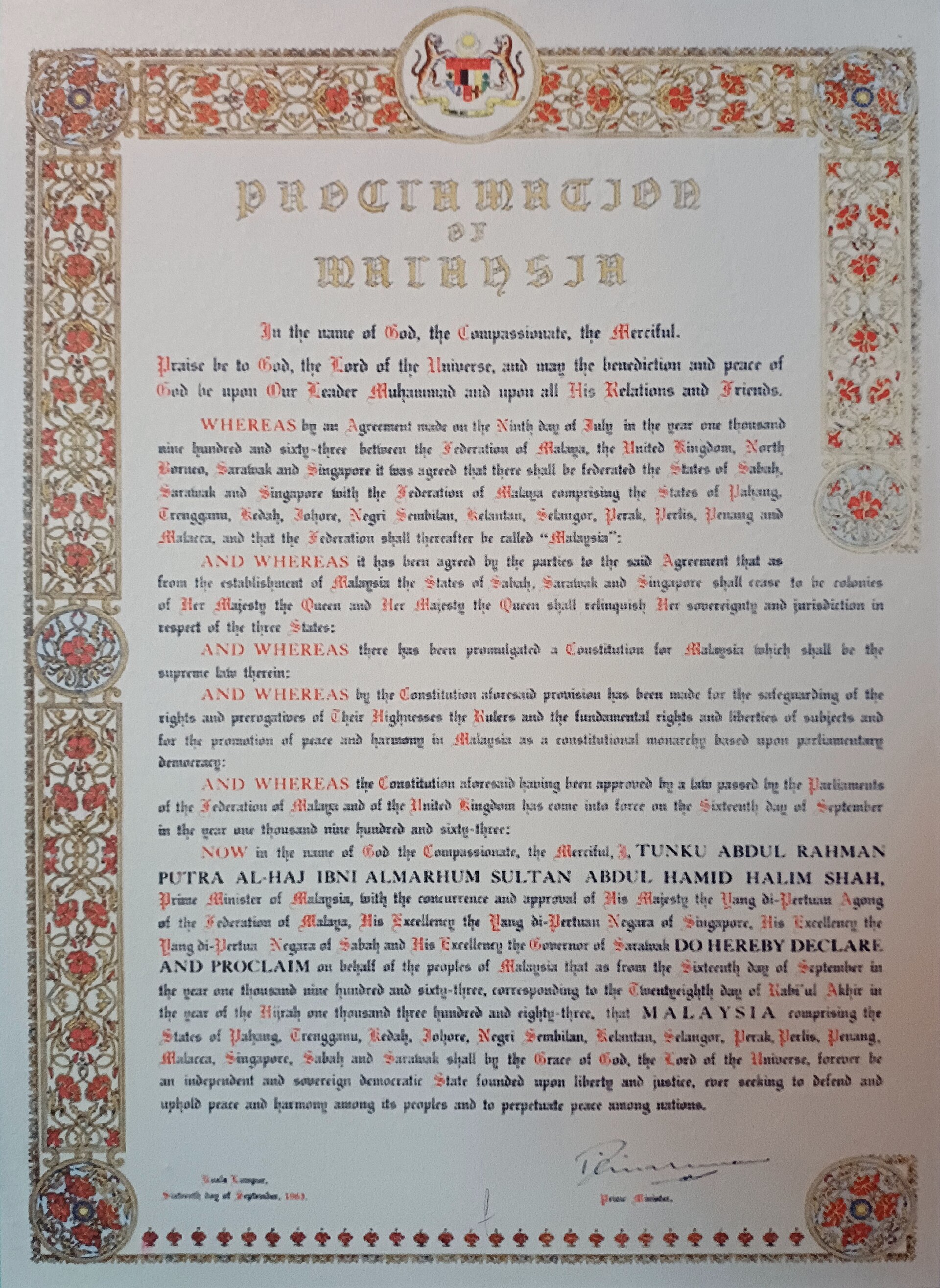
Formation of Malaysia
Malaysia was created on 16 September 1963 when the Federation of Malaya joined with Singapore, North Borneo (Sabah) and Sarawak under the Malaysia Agreement 1963, and the terms of that founding bargain are still argued over in Parliament today.
Photo: Taufik · Public domain · Wikimedia Commons
what happened
Malaysia did not exist before 16 September 1963. On that day the Federation of Malaya, which had been independent since 1957, joined with Singapore and the two British Borneo colonies of North Borneo and Sarawak to form a larger federation. The legal instrument was the Agreement relating to Malaysia, signed in London on 9 July 1963 by the United Kingdom, Malaya, North Borneo, Sarawak and Singapore. Britain passed the Malaysia Act 1963 to give up sovereignty over the three joining territories. The founding date was originally 31 August 1963 and was pushed back to 16 September by an amending agreement signed in Singapore on 28 August.
Before the merger, two consultations took place. A commission of enquiry chaired by Lord Cobbold reported in 1962 that federation was in the best interests of North Borneo and Sarawak, and Lord Lansdowne told the House of Lords in August 1962 that the commissioners were unanimous on that point and that safeguards would be drawn up covering religion, education, representation in the federal Parliament, the position of indigenous races, immigration control, citizenship and the state constitutions. The Inter-Governmental Committee then reported in February 1963; Article VIII of the Malaysia Agreement required the governments to implement the assurances, undertakings and recommendations in Chapter 3 of that report. The page does not establish a point-by-point correspondence between that report and Sabah's 20 points or Sarawak's 18 points. Separately, after Indonesia and the Philippines objected, UN Secretary-General U Thant sent a mission whose conclusions of 14 September 1963 reported no doubt about the wishes of a sizeable majority in the two territories to join.
The consultation is exactly where accounts diverge. Lord Lansdowne reported the commissioners' unanimous conclusion that federation was in the territories' best interests. Voon Lee Shan, a Sarawak lawyer and former assemblyman, argues instead that only about 4,000 of Sarawak's roughly 700,000 people were interviewed and that this could not represent the territory. The page does not resolve that disagreement.
The federation as founded did not last in its original shape. Indonesia and the Philippines withheld recognition, and Indonesia pursued armed confrontation from late 1963. Brunei negotiated but did not join, with the disagreement centring on control of its revenue and its oil and gas wealth. Singapore left on 9 August 1965 by agreement and constitutional amendment. In 1963, Sabah, Sarawak and Singapore together held 55 of the 159 Dewan Rakyat seats (about 34.6 per cent); Sabah and Sarawak now hold 56 of 222 seats, about 25 per cent. Sarawak Deputy Speaker Idris Buang says the founding documents support restoring a one-third share; former Speaker Azhar Harun says nothing in those documents specifies such a share.
The other running dispute is constitutional and financial. Article 1(2) originally listed the states in three groups, including Singapore; after Singapore left, a 1976 amendment merged the remaining states into one alphabetical list. Parliament restored a two-group wording in December 2021, though the lawyer Wilson Tay Tze Vern argues that rewording alone will not settle the substantive issues. Article 161E still requires the consent of Sabah's or Sarawak's Yang di-Pertua Negeri before a range of provisions affecting them can be amended. On money, the special-grant provisions in Articles 112C and 112D are the subject of negotiation, with interim payments raised to RM600 million per state from 2025, and litigation, with the High Court in Sabah and Sarawak ruling in November 2025 in favour of the Sabah Law Society on the reviews the federal government had failed to conduct. For a first-time voter, the practical point is that 1963 is not only history: seat allocation, revenue shares and the meaning of "equal partner" are still on the parliamentary agenda.
the working
What the sources say
established
The Agreement relating to Malaysia was signed in London on 9 July 1963 between the United Kingdom, the Federation of Malaya, North Borneo, Sarawak and Singapore; signatories included Harold Macmillan and Duncan Sandys for the United Kingdom and Tunku Abdul Rahman and Abdul Razak for the Federation of Malaya
Agreement relating to Malaysia · Signing of the Malaysia Agreement
established
Article I of the Agreement provides that "The Colonies of North Borneo and Sarawak and the State of Singapore shall be federated with the existing States of the Federation of Malaya as the States of Sabah, Sarawak and Singapore"
established
The Agreement originally set 31 August 1963 as the day Malaysia would come into being; an amending agreement signed at Singapore on 28 August 1963 moved the date to 16 September 1963
Agreement relating to Malaysia · Malaysia Agreement overview
established
Article IV of the Agreement records the United Kingdom's undertaking to relinquish "Her Britannic Majesty's sovereignty and jurisdiction in respect of North Borneo, Sarawak and Singapore" with effect from Malaysia Day
established
The United Kingdom gave effect to its side through the Malaysia Act 1963 (c. 35), "An Act to make provision for and in connection with the federation of North Borneo, Sarawak and Singapore with the existing States of the Federation of Malaya", which received Royal Assent on 31 July 1963
established
Article VIII of the Agreement obliged the governments to implement the assurances, undertakings and recommendations in Chapter 3 of the Inter-Governmental Committee Report of 27 February 1963
established
A Commission of Enquiry chaired by Lord Cobbold — with Sir Anthony Abell, Sir David Watherston, Dato Wong Pow Nee and Muhammad Ghazali bin Shafie as members — was appointed to enquire into opinion in North Borneo and Sarawak, and its report is dated June 1962
established
Reporting the Commission's conclusions to the House of Lords on 1 August 1962, the Marquess of Lansdowne said the commissioners "were unanimously agreed that a Federation of Malaysia is in the best interests of North Borneo and Sarawak and that an early decision in principle should be reached"
established
Lansdowne told the House of Lords the agreed safeguards would "cover such matters as religious freedom, education, representation in the Federal Parliament, the position of the indigenous races, control of immigration, citizenship and the State constitutions"
established
The Inter-Governmental Committee, chaired by Lord Lansdowne with Tun Abdul Razak as deputy chairman, reported in February 1963; Article VIII of the Malaysia Agreement obliged the governments to implement the assurances, undertakings and recommendations in Chapter 3 of that report
established
Following a request made on 5 August 1963 by the governments of the Federation of Malaya, Indonesia and the Philippines, UN Secretary-General U Thant sent a mission to ascertain the wishes of the people of Sabah and Sarawak; his final conclusions, published 14 September 1963, stated there was "no doubt about the wishes of a sizeable majority of the peoples of these territories to join in the Federation of Malaysia"
United Nations Malaysia Mission Report · Final conclusions of the Secretary-General regarding Malaysia
established
Brunei took part in the merger negotiations but did not join; on 21 June 1963 Deputy Prime Minister Abdul Razak wrote to the Sultan of Brunei listing outstanding issues, and the sticking points concerned control of Brunei's revenue and its oil and gas wealth
established
At Malaysia's formation the Dewan Rakyat had 159 seats: 104 from Malaya, 24 from Sarawak, 16 from Sabah and 15 from Singapore
Behind the 35% share of Dewan seats for Sabah · Sarawak think tank calls for restoration of 35 per cent parliamentary seats to Borneo states
established
Indonesia and the Philippines withheld recognition of the new federation; Indonesia recalled its ambassador and President Sukarno pursued the "Ganyang Malaysia" confrontation campaign, with the first major armed clash at Long Jawai in Sarawak on 28 September 1963
How Konfrontasi Reshaped Southeast Asian Regional Politics · Indonesia–Malaysia Confrontation
established
Singapore left the federation on 9 August 1965: the Independence of Singapore Agreement was concluded on 7 August 1965, and the Constitution and Malaysia (Singapore Amendment) Bill was passed in the Dewan Rakyat on 9 August 1965 by 126 votes to none with one abstention, receiving Royal Assent the same day
Singapore's separation from Malaysia · Separation 1965: The Tunku's agonised decision
established
Singapore's 15 seats were redistributed to Peninsular Malaysia after 1965; the Dewan Rakyat now has 222 seats, of which Sarawak holds 31 and Sabah 25, about 25 per cent of the House
established
Article 1(2) of the Federal Constitution as it stood from 1963 listed the States of the Federation in three categories: the States of Malaya, the Borneo States of Sabah and Sarawak, and the State of Singapore. After Singapore left in 1965, a 1976 amendment replaced the wording with a single alphabetical list of thirteen states
established
A constitutional amendment restoring the two-category wording of Article 1(2) was passed by the Dewan Rakyat on 14 December 2021 with the support of 200 MPs and approved by the Dewan Negara on 22 December 2021
established
Article 161E of the Federal Constitution requires the concurrence of the Yang di-Pertua Negeri of Sabah or Sarawak before certain constitutional provisions affecting those states can be amended, covering matters including citizenship, the High Court in Sabah and Sarawak, legislative and executive powers, financial arrangements, religion, language, the special treatment of natives, and the allocation of seats in the House of Representatives
established
Malaysia Day, 16 September, became a nationwide public holiday from 2010 after Prime Minister Najib Razak told Parliament that "Cabinet has decided to make Sept 16 a public holiday"
adjudicated
The Federal Government decided not to appeal the Kota Kinabalu High Court’s 2025 decision on Sabah’s 40 per cent special grant and said negotiations with Sabah would begin; the decision concerned that special-grant ruling, not every MA63-related issue.
uncertain
Cobbold Commission material confirms that the Commission heard people and bodies, but no verified total witness figure or single authoritative 1963 population source for both Sabah and Sarawak has been located.
searched: Parliament, National Archives material, and Cobbold-report records
where accounts differ
The parts nobody agrees on
contested
Whether the Cobbold Commission established genuine majority consent is contested. In reporting the Commission's conclusion to the House of Lords, the Marquess of Lansdowne said the commissioners were unanimously agreed that a Federation of Malaysia was in the best interests of North Borneo and Sarawak
contested
Voon Lee Shan, a lawyer and former Batu Lintang assemblyman, argued in October 2018 that the Cobbold report was misleading because roughly 4,000 of Sarawak's then 700,000 people were interviewed, saying "With only less than one per cent of the people being interviewed, the 4,000 odd people could not represent the voice of the whole Sarawak at that time," and concluding that MA63 was void from the outset
contested
Whether MA63 entitles Sabah and Sarawak to one-third of Dewan Rakyat seats, or to the approximately 34.6 per cent represented by 55 of the original 159 seats, is disputed. Sarawak Deputy Speaker Idris Buang said on 29 September 2025 that the IGC report and Cobbold Commission support the claim, citing the IGC statement that "the proportion of seats allocated respectively to Sarawak and Sabah should not be reduced"
contested
Former Dewan Rakyat Speaker Azhar Harun said in September 2025 that having reviewed the Federal Constitution, the Malaysia Act 1963, MA63 and the IGC report, "There is nothing in these documents specifying that Sabah, Sarawak and Singapore are to occupy 35% of the seats (in the lower house)"
MA63 never stipulated that Sabah · AGC urged to reveal legal views on MA63 and 35% parliamentary seat claim
contested
Why Malaysia was formed is explained differently by different scholars. Historian Cheah Boon Kheng wrote in 2007 that for Tunku Abdul Rahman "the most important... was ethnic composition", the Borneo territories offsetting Singapore's addition; that Lee Kuan Yew sought merger because communists were pressuring his party in Singapore; and that critics including Sukarno viewed Malaysia as a neo-colonial arrangement
contested
Whether the 1976 amendment to Article 1(2) changed anything legally is disputed among lawyers. Wilson Tay Tze Vern argues the amendment restoring the old wording will not by itself resolve the underlying issues, since the special powers of Sabah and Sarawak derive from other constitutional provisions and the socioeconomic grievances need substantive measures
adjudicated
The financial terms of MA63 remain in active dispute. On 7 November 2025 the High Court in Sabah and Sarawak at Kota Kinabalu, per Celestina Stuel Galid J, allowed the Sabah Law Society's judicial review, holding that a review order was "illegal, irrational, procedurally improper and/or disproportionate" for omitting the 40 per cent entitlement for the years 1974 to 2021
Sabah Law Society v The Government of the Federation of Malaysia & Anor
established
Articles 112C and 112D provide for special grants to Sabah and Sarawak, and interim special-grant payments were raised to RM600 million for each state from 2025
Constitution of Malaysia · Increase In Special Grant For Sabah
contested
Federal and state governments differ on how the special-grant provisions should be applied. The federal side presents the RM600 million payments as recognition of MA63 claims, while some Borneo commentators describe them as inadequate
Increase In Special Grant For Sabah · MA63: What Sabah and Sarawak Wants
uncertain
Whether Sarawak and Sabah were separately independent before 16 September 1963, and what that implies, is argued about. Commentators point to Britain granting Sarawak self-government on 22 July 1963 and to 31 August 1963 for North Borneo; the significance attached to those dates differs between state and federal accounts
still being researched
- Which of Sabah's 20 points and Sarawak's 18 points were accepted, modified or dropped in the Inter-Governmental Committee Report, point by point.