Merdeka → GE16 · every fact sourced

Every seat.Every coalition.Every vote.

69 years of Malaysian politics. One scroll.

Who was in power, how the coalitions split and merged, and what actually happens when you vote — neutral, sourced, and written for first-time voters.

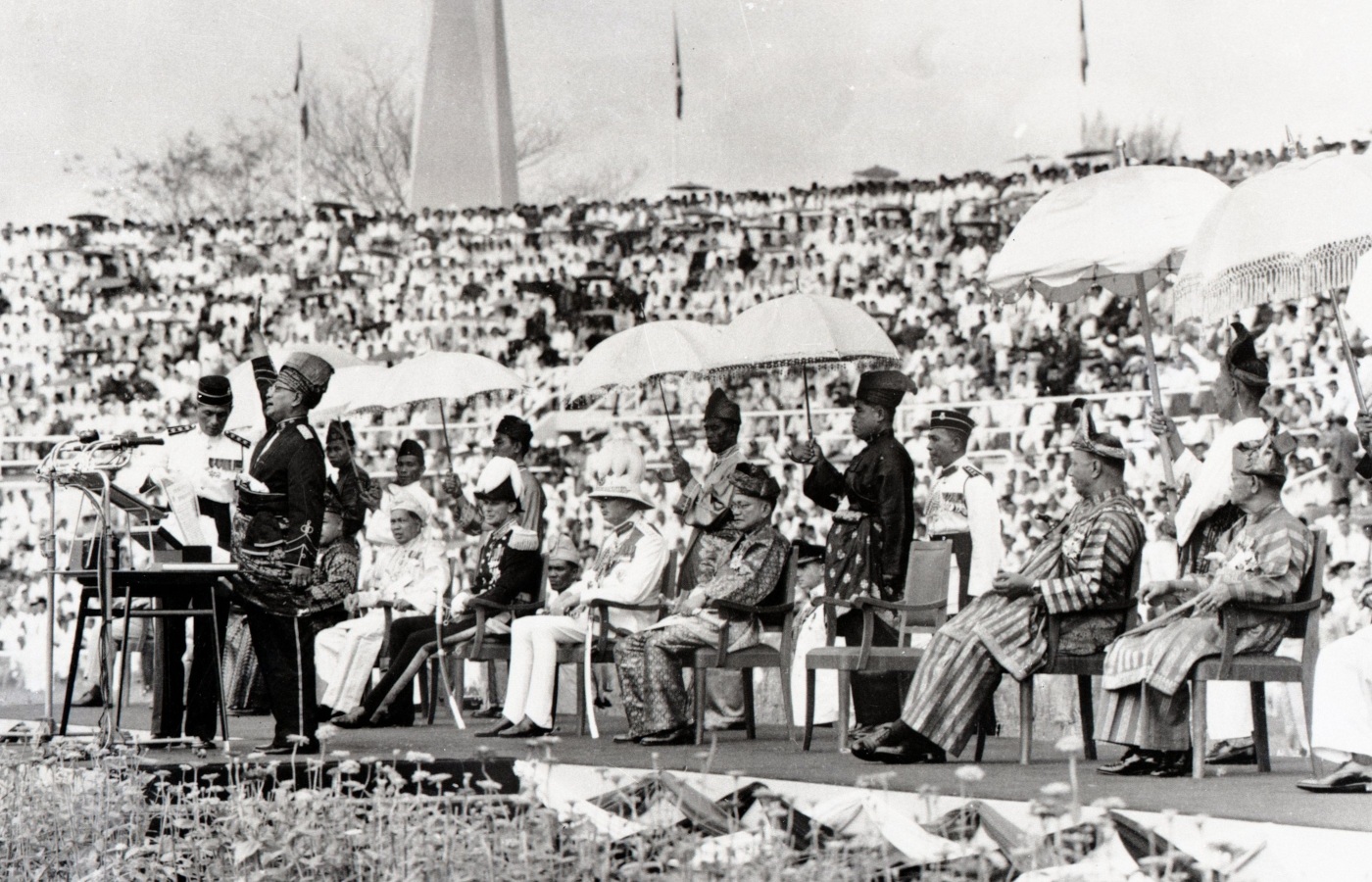
Photo: Kerajaan Tanah Melayu · Public domain · Wikimedia Commons

scroll ↓

Start here

If you know nothing else, know this

Malaysian politics looks like an alphabet soup of coalitions. Underneath it there is one simple machine, and it only has three moving parts.

Start here · the one thing to understand

222seats in the Dewan Rakyat

1 · your ballot

You vote for one person, in one place

On polling day you mark one name: the Member of Parliament for your own constituency. There are 222 constituencies, so there are 222 of these votes happening at once, each one entirely separate from the others.

2 · the chamber

Those 222 winners are the Dewan Rakyat

Article 43(2)(a) says the Agong — Malaysia's King — must appoint as Prime Minister "a member of the House of Representatives who in his judgment is likely to command the confidence of the majority of the members of that House."

from “What happens after polling” — sourced in full below

3 · the number that decides everything

112 is the whole game

Majority, in a 222-seat Dewan Rakyat, means 112 MPs. Note what that sentence counts: members, not coalitions.

from “What happens after polling” — sourced in full below

Which means the entire history of Malaysian politics can be told as one question, election after election: who held these seats?

The Coalition River

Every seat in Parliament,every election since 1955

Each stream is a political lineage — a family of parties that stayed together, renamed itself, or broke apart. The river is as wide as Parliament itself, so it grows from 52 seats in 1955 to 222 today. The line down the middle is half the chamber: whoever covers it is close to the 112 seats you need to govern.

The Coalition River · 1955 → today

195519551959GE11964GE21969GE31974GE41978GE51982GE61986GE71990GE81995GE91999GE102004GE112008GE122013GE132018GE142022GE151955 Federal Legislative Council electionMay 13 incidentGE4GE8GE10GE12GE14Sheraton MoveGE15195519551969GE31982GE61995GE92008GE122022GE151955 Federal Legislative Council electionMay 13 incidentGE4GE8GE10GE12GE14Sheraton MoveGE15
Alliance / BNPR / PH lineagePAS-led (APU · BA · PN)Other / IndependentGPS (Sarawak)GRS (Sabah)middle line = half the chamber (112 seats to govern today)

Whose coalition is which:Barisan Nasional (BN) · Pakatan Harapan (PH) · Pakatan Rakyat (PR) · Perikatan Nasional (PN)

GE

27 July 1955

1955 Federal Legislative Council election

First nationwide federal election before Merdeka; Alliance won 51 of 52 seats.

The full account →

Chamber of 52Alliance/BN 51PAS-led 1
Event

13 May 1969handled with care

May 13 incident

Post-GE3 riots; Parliament suspended; NOC rule.

The full account →

GE

24 August 1974

GE4

First election contested by the new Barisan Nasional under Abdul Razak.

The full account →

Chamber of 154Alliance/BN 135PR/PH 9Other 10
GE

21 October 1990

GE8

First serious two-front challenge: Semangat 46 with Gagasan Rakyat and APU.

The full account →

Chamber of 180Alliance/BN 127PR/PH 28PAS-led 7Other 18
GE

29 November 1999

GE10

Post-Reformasi election in which Barisan Alternatif contested and PAS increased its parliamentary representation.

The full account →

Chamber of 193Alliance/BN 148PR/PH 15PAS-led 27Other 3
GE

8 March 2008

GE12

The 'political tsunami': BN lost two-thirds majority and five states; birth of Pakatan Rakyat.

The full account →

Chamber of 222Alliance/BN 140PR/PH 82
GE

9 May 2018

GE14

Malaysia's first federal change of government; Pakatan Harapan defeated BN.

The full account →

Chamber of 222Alliance/BN 79PR/PH 113PAS-led 18Other 12
Event

23 February 2020

Sheraton Move

A rapid realignment that ended the PH government and reshaped federal coalitions; Muhyiddin sworn in.

Walk through this one day by day →

GE

19 November 2022

GE15

First hung parliament; resolved by the unity government under Anwar Ibrahim.

The full account →

Chamber of 222Alliance/BN 30PR/PH 82PAS-led 74Other 7GPS 23GRS 6

And that is the Parliament you will vote for at GE16: 6 streams, and at the last election none of them came close to 112 on its own.

Data: SPR results via ElectionData.MY (CC0) and a hand-verified historical chamber table; GE12–15 verified seat-for-seat against official EC results. Streams group parties by lineage — full detail on each coalition page.

The full timeline

From Malayan Union to the road to GE16

Elections are the anchor points; the events between them are why each one turned out the way it did.

Before Merdeka

colonial rule to independence

1946
Malayan Union and Federation of Malaya (1946-1948)

Between 1946 and 1948 Britain set up a unitary Malayan Union with a broad common citizenship, met organised Malay opposition, and replaced it two years later with the Federation of Malaya. Its federal structure was carried into independent Malaya, while its citizenship rules were changed in the 1950s and again at independence.

More on this

After the Japanese occupation ended, Britain returned to Malaya with a plan to replace a patchwork of Malay states and Straits Settlements with one administration. Sir Harold MacMichael obtained treaties from all nine Malay Rulers under which they gave up, in one account's words, virtually all their sovereign powers except those touching religion and Malay culture. The policy was published as a command paper in January 1946, the Straits Settlements were dissolved by legislation at Westminster, and the Malayan Union began with Sir Edward Gent installed as Governor on 1 April 1946. Singapore was deliberately left outside as a separate colony.

The full page, with sources →

1948-06
Malayan Emergency (1948-1960)

This page covers the twelve-year armed conflict in Malaya between British and Commonwealth forces and the armed wing of the Communist Party of Malaya, and the marks it left on Malaysian citizenship, security law and the road to independence.

More on this

The conflict now usually called the Malayan Emergency began in June 1948, days after three European plantation managers were killed near Sungai Siput in Perak. Emergency was declared in Perak and Johor on 16 June, extended across the Federation on 18 June and to Singapore on 24 June. The fighting set Commonwealth forces against the Malayan National Liberation Army, the armed wing of the Communist Party of Malaya — a party that had fought the Japanese occupation with British training, and whose relationship with Britain broke down over the post-war years of strikes and restrictions on communist-led unions. The name is not neutral ground: the British called it an emergency, while the communist side called its campaign the Anti-British National Liberation War, and a much-repeated story that "emergency" was chosen to protect rubber and tin insurance claims remains poorly documented.

The full page, with sources →

1955-07-27
1955 Federal Legislative Council election

First nationwide federal election before Merdeka; Alliance won 51 of 52 seats.

More on this

This was Malaya’s first federal general election. The previously constituted Federal Legislative Council was dissolved so that voters could elect 52 members.

The full page, with sources →

1956
Reid Commission (1956-57)

This page covers the five-member commission that produced the draft constitution for an independent Malaya, the bargains written into its report, and the places where the constitution actually adopted in 1957 — after a tripartite Working Party revised the draft — differed from what the commission recommended.

More on this

The Reid Commission was appointed in 1956 to recommend a constitution for an independent Malaya. Its five members reported on 21 February 1957 with a draft constitution; that draft was one stage in the process, not the constitution enacted at independence.

The full page, with sources →

1957-08-31
Merdeka (1957)

On 31 August 1957 the Federation of Malaya became an independent country. This page examines the independence constitution and later debates about citizenship, language, religion and the special position of the Malays.

More on this

Independence did not arrive as a single event. Malaya's first federal election, on 27 July 1955, returned the Alliance of UMNO, MCA and MIC in 51 of the 52 elected seats and made Tunku Abdul Rahman Chief Minister. That mandate carried him to London, where on 8 February 1956 an agreement concluded at Lancaster House fixed 31 August 1957 as the date. The British Parliament then passed the Federation of Malaya Independence Act 1957, an Act to establish the Federation "as an independent sovereign country within the Commonwealth." On the day itself, Tunku Abdul Rahman moved from Chief Minister to first Prime Minister, and foreign governments sent representatives — the United States delegation was led by Under Secretary of State Christian A. Herter.

The full page, with sources →

The Alliance years

Merdeka to the 1969 election

1959-08-19
GE1 (1959)

First post-independence general election; Alliance government under Tunku Abdul Rahman.

More on this

The post-independence federal election followed the dissolution of the Federal Legislative Council on 27 June 1959. State elections had already been held between May and June; PMIP won 28 of 30 seats in Kelantan and 13 of 24 in Terengganu.

The full page, with sources →

1963-09-16
Formation of Malaysia (1963)

Malaysia was created on 16 September 1963 when the Federation of Malaya joined with Singapore, North Borneo (Sabah) and Sarawak under the Malaysia Agreement 1963, and the terms of that founding bargain are still argued over in Parliament today.

More on this

Malaysia did not exist before 16 September 1963. On that day the Federation of Malaya, which had been independent since 1957, joined with Singapore and the two British Borneo colonies of North Borneo and Sarawak to form a larger federation. The legal instrument was the Agreement relating to Malaysia, signed in London on 9 July 1963 by the United Kingdom, Malaya, North Borneo, Sarawak and Singapore. Britain passed the Malaysia Act 1963 to give up sovereignty over the three joining territories. The founding date was originally 31 August 1963 and was pushed back to 16 September by an amending agreement signed in Singapore on 28 August.

The full page, with sources →

1964-04-25
GE2 (1964)

Held during Konfrontasi with Indonesia; Alliance strengthened.

More on this

Parliament was dissolved on 1 March, leaving 55 days until polling on 25 April. Malaysia was less than a year old, and the federal election did not directly elect the representatives from Sabah, Sarawak and Singapore; Vasil’s contemporary study therefore treated the contest as one in mainland Malaya.

The full page, with sources →

1965-08-09
Singapore separation (1965)

On 9 August 1965 Singapore ceased to be a state of Malaysia, less than two years after joining, and this page sets out the documents, dates and actors involved, the constitutional and economic disputes that preceded it, the direct effects on federal politics, and the parts of the story that Malaysian and Singaporean accounts still tell differently.

More on this

Malaysia was formed on 16 September 1963 by joining the Federation of Malaya with Sabah, Sarawak and Singapore. Five days later Singapore held a state election in which the PAP won 37 of 51 seats, and the following year the PAP crossed to the peninsula, contesting nine seats in the 1964 federal election and winning one, Bangsar. Less than two years after formation, on 7 August 1965, the two governments signed an agreement at Kuala Lumpur providing that Singapore would cease to be a state of Malaysia on 9 August 1965 and become an independent and sovereign state, recognised as such by Malaysia. The agreement is short. It names itself the Independence of Singapore Agreement, sets the date, and requires Malaysia to proclaim the separation and to secure an Act of Parliament giving it effect.

The full page, with sources →

1966
Sarawak constitutional crisis (1966)

In 1966 Sarawak's first Chief Minister was removed by the state Governor, put back by a court, and then removed again after the federal government declared an emergency and used it to change the state constitution. Andrew Harding describes the episode as a precedent for later federal interference in Sabah and Sarawak.

More on this

Stephen Kalong Ningkan became Sarawak's first Chief Minister on 22 July 1963, leading the majority party in the state legislature, the Council Negri. In June 1966 the Governor, Tun Abang Haji Openg, received representations that a majority of Council Negri members no longer had confidence in him. Those representations took the form of a signed letter rather than a vote in the chamber. The Governor asked Ningkan to resign; when he refused, the Governor declared him dismissed and appointed Penghulu Tawi Sli in his place.

The full page, with sources →

1969-05-10
GE3 (1969) handled with care

The completed 144-seat result table records Perikatan with 90 seats—below the 96 needed for a two-thirds majority; the election was followed by the 13 May violence and an emergency suspension of parliamentary rule.

More on this

The Dewan Rakyat and almost all state assemblies were dissolved on 20 March 1969. Parliamentary nominations followed on 5 April and the main polling day in the States of Malaya was 10 May.

The full page, with sources →

1969-05-13
May 13 incident (1969) handled with care

Post-GE3 riots; Parliament suspended; NOC rule.

More on this

On 13 May 1969, three days after a general election, communal violence broke out in Kuala Lumpur, primarily between Malay and Chinese communities. It was the deadliest civil violence in Malaysia's history. The government's official count is 196 dead; credible independent estimates run several times higher, and the honest answer is that no one knows the true number.

The full page, with sources →

May 13 and the BN era

emergency rule, the NEP, BN dominance

1969
National Operations Council rule (1969-1971)

Between May 1969 and February 1971 Malaysia was governed under a Proclamation of Emergency rather than through a sitting Parliament. Under the Emergency (Essential Powers) Ordinance No. 2 of 1969 the executive authority of the Federation was delegated to a Director of Operations, who was required to act on the Prime Minister's advice and was to be assisted by a body called the National Operations Council. This page covers how that arrangement was created, what legal powers it used, and how parliamentary government was restored.

More on this

On 15 May 1969, two days after the disturbances in Kuala Lumpur, the Yang di-Pertuan Agong proclaimed a state of emergency under Article 150 of the Federal Constitution. Article 150 allows such a proclamation where security, economic life or public order is threatened, and it carries with it the power to make ordinances that have the force of law. Two days later a second ordinance vested the executive authority of Malaysia in a Director of Operations — Deputy Prime Minister Tun Abdul Razak Hussein — who was required to act on the Prime Minister's advice, and created a body to assist him: the National Operations Council, known in Malay as Majlis Gerakan Negara or MAGERAN. Four actors are worth keeping apart. The Yang di-Pertuan Agong proclaimed the emergency and designated the Director. The Prime Minister, still Tunku Abdul Rahman, remained in office and his advice bound the Director. The Director held the executive authority. The Council advised and assisted him, and its members were his own appointees. The Tunku relinquished the premiership in September 1970 and Abdul Razak succeeded him, at which point the same man held both offices. It is common to read that the Council governed the country — The Rakyat Post calls MAGERAN "a caretaker government to temporarily govern the country", and Malaysiakini describes the ordinances as delegating executive and legislative powers to the Council — but on the text of the ordinance the authority sat with the Director.

The full page, with sources →

1971
AUKU / Universities and University Colleges Act (1971, amended 1975)

This page explains how AUKU shaped university students’ ability to take part in Malaysian political life, and how those restrictions were later eased.

More on this

AUKU began as a law for establishing and administering universities and university colleges. Its 1975 amendment, Act A295, was a major change: it restricted students from joining or supporting political parties, trade unions and other groups, and it linked criminal charges to suspension or dismissal from university.

The full page, with sources →

1971
Constitution (Amendment) Act 1971 - sensitive matters

This page sets out what the Constitution (Amendment) Act 1971 changed in Malaysia's Federal Constitution, when and how it was passed, and how it connects to the Sedition Act 1948.

More on this

The Constitution (Amendment) Act 1971 — Act A30 — took effect on 10 March 1971. It was passed by a Parliament that had only just resumed sitting: after the violence of 13 May 1969 a Proclamation of Emergency was issued under Article 150 and the country was run through the National Operations Council, with Parliament reconvening on 20 February 1971. The 1976 Malaya Law Review survey of Malaysia's constitutional amendments records that the Act embodied many of the conclusions reached by the National Consultative Council, a body that included members of all races and political parties except the Democratic Action Party, which had declined to sit on it.

The full page, with sources →

1971
New Economic Policy launch (1971)

This page covers how the New Economic Policy was launched in 1971, what its own planning documents said it was for, what the official numbers show, and which parts of its record remain disputed.

More on this

In July 1971 the government tabled the Second Malaysia Plan, and with it the framework that has shaped Malaysian economic argument ever since. The plan was drafted in the period between the May 1969 election and its aftermath and the plan's tabling, under the administration led by Tun Abdul Razak, and the Economic Planning Unit's own later account traces its framing back to the Rukunegara, formulated after May 1969 as a basis for national unity.

The full page, with sources →

1974
Petroleum Development Act 1974

The 1974 law that placed ownership of all Malaysian petroleum in a single federal company, PETRONAS. The Act itself names no percentage; the 5% cash payment that Sabah and Sarawak politicians have argued over ever since comes from the separate state agreements signed under it in 1975 and 1976.

More on this

The Petroleum Development Act 1974 is short, and its central move is contained in one sentence. Section 2(1) vests "the entire ownership in, and the exclusive rights, powers, liberties and privileges of exploring, exploiting, winning and obtaining petroleum whether onshore or offshore of Malaysia" in a single corporation. Section 3 names that corporation PETRONAS and places it under the direction of the Prime Minister. The Act took effect on 1 October 1974, and the transfer itself only became operative once each state executed the one-paragraph instrument set out in the Schedule, which grants the rights "in perpetuity" and says the grant "shall be irrevocable."

The full page, with sources →

1974-08-24
GE4 (1974)

First election contested by the new Barisan Nasional under Abdul Razak.

More on this

GE4 followed an early dissolution of Parliament on 31 July 1974. Nomination day was 8 August, with the main Peninsular polling date on 24 August; Sabah and Sarawak voted later under the election timetable.

The full page, with sources →

1976-06-06
Double Six crash (1976)

On 6 June 1976 a light aircraft crashed on approach to Kota Kinabalu, killing Sabah's chief minister and four other members of the new state government, and this page sets out what the records establish about the crash, what followed it in state and federal politics, and which questions are still argued over fifty years later.

More on this

On the afternoon of 6 June 1976 a Sabah Air Nomad aircraft flying from Labuan came down in shallow water off Kampung Sembulan, about two kilometres short of Kota Kinabalu airport. All 11 people on board died. Among them were Chief Minister Tun Fuad Stephens, four other members of the state government, two senior state officials, the secretary to the federal finance minister, the chief minister's bodyguard, the chief minister's son and the pilot. The date gave the event its name in Sabah: Double Six.

The full page, with sources →

1978-07-08
GE5 (1978)

Hussein Onn led Barisan Nasional (BN) at the first general election held after he succeeded Abdul Razak as Prime Minister in 1976.

More on this

Hussein Onn called the election in June 1978, after serving for more than two years as Prime Minister following Abdul Razak’s death. Nomination was held on 21 June, leaving a short campaign before the main polling day of 8 July. Public political rallies were banned during that period.

The full page, with sources →

1981
Amanat Hadi (1981) handled with care

This page explains the 1981 Abdul Hadi Awang speech commonly called “Amanat Hadi,” why its meaning remains disputed, and how it became part of UMNO–PAS political debate.

More on this

On 7 April 1981, Abdul Hadi Awang gave a public speech in Banggol Peradong, Kuala Terengganu. A circulated extract later became known as “Amanat Haji Hadi,” although academic work and PAS representatives have said the label came from the later poster rather than from a formal fatwa or the speech’s original title.

The full page, with sources →

1982-04-22
GE6 (1982)

Mahathir's first general election as PM; BN won a large parliamentary majority.

More on this

Parliament was dissolved on 29 March, and voters went to the polls on 22 April. This was Mahathir Mohamad’s first general election as Prime Minister after he succeeded Hussein Onn in 1981. Crouch’s contemporaneous study says the election was presented as a mandate for the new Prime Minister.

The full page, with sources →

1983
1983 constitutional crisis

This page explains the 1983–84 dispute between Mahathir Mohamad’s federal government and Malaysia’s Rulers over how Bills become law and who may declare an emergency.

More on this

In 1983, Mahathir Mohamad’s government introduced constitutional amendments that would have changed two important safeguards in federal politics: the process for royal assent to Bills and the power to declare an emergency. The proposal included a 15-day rule under which a Bill could become law without assent, and it moved emergency-declaration authority to the Prime Minister.

The full page, with sources →

1983
BMF scandal (1983)

This page covers the large, mostly unsecured Hong Kong property loans made by Bumiputra Malaysia Finance, the Hong Kong finance subsidiary of the state-linked Bank Bumiputra Malaysia Berhad; the 1983 collapse of the borrowers that turned those loans into losses; the murder of the bank officer sent to examine them; and what followed in Malaysian politics.

More on this

Bumiputra Malaysia Finance was the Hong Kong arm of Bank Bumiputra Malaysia Berhad, a bank created under Malaysian government ownership to widen Bumiputera participation in commerce. From 1979 it lent heavily into Hong Kong's property boom, above all to the Carrian group run by George Tan. The Ahmad Nordin inquiry later put the Carrian lending alone at about US$800 million between 1979 and 1983, most of it approved without adequate security or proper procedure, and contemporaneous reporting counted roughly US$1 billion across three Hong Kong property groups. In Malaysian debate a figure of RM2.5 billion has commonly been used for the exposure.

The full page, with sources →

1986-08-03
GE7 (1986)

Held amid economic downturn; prelude to the UMNO Team A/Team B split.

More on this

The election came before the expected end of the parliamentary term. Mahathir decided on an early dissolution on 18 July, and Parliament was formally dissolved the following day.

The full page, with sources →

1987-10-27
Ops Lalang (1987) handled with care

Ops Lalang was a police operation beginning on 27 October 1987 in which more than a hundred people were detained without trial under the Internal Security Act 1960 and the publishing permits of four newspapers were withdrawn.

More on this

Ops Lalang began on 27 October 1987, when police started making arrests under the Internal Security Act 1960. Over the following weeks more than a hundred people were detained. They were not drawn from a single party or community: opposition MPs from the DAP and PAS, leaders of the Chinese-education movement, trade unionists, academics, lawyers, church workers, Islamic preachers and NGO activists were all picked up. The police gave the purpose of the operation as forestalling racial rioting. Sources differ on the exact total, giving figures between 106 and 119.

The full page, with sources →

1988
1988 judicial crisis

This page explains the 1988 conflict over Malaysia’s top court, the removal of its head, and why the episode remains important to debates about judicial independence.

More on this

In 1988, a dispute about the place of courts in Malaysia’s constitutional system became a major federal political event. The law allowed the removal of a top judge through an Article 125 tribunal, and Parliament amended Article 121(1) on 10 June to replace wording that expressly vested the Federation’s judicial power in the courts.

The full page, with sources →

1988
UMNO Team A vs Team B and deregistration (1987-1988)

In 1987 the country's largest party split into two factions over its presidency, and within ten months a court ruling on unregistered branches ended the original UMNO's legal existence and produced two new parties in its place.

More on this

UMNO's party elections on 24 April 1987 were the closest in its history. Two organised camps contested them: Team A, around party president and Prime Minister Mahathir Mohamad, and Team B, led by Tengku Razaleigh Hamzah together with former Deputy Prime Minister Musa Hitam. Mahathir kept the presidency by 43 votes, on figures usually given as 761 to 718. A margin that narrow put the eligibility of individual delegates at the centre of what followed.

The full page, with sources →

Two fronts and Reformasi

Semangat 46 to the 2004 high-water mark

1990-10-21
GE8 (1990)

First serious two-front challenge: Semangat 46 with Gagasan Rakyat and APU.

More on this

Parliament was dissolved on 5 October, setting a ten-day campaign before polling on 20–21 October. The short timetable had been widely expected; the Commonwealth Observer Group said the government and Election Commission presented it as a security precaution, while some political parties told the group it disadvantaged them.

The full page, with sources →

1991-02-28
Vision 2020 (1991)

On 28 February 1991 Prime Minister Mahathir Mohamad presented a paper called "Malaysia: The Way Forward" that set the goal of Malaysia becoming "a fully developed country by the year 2020".

More on this

On 28 February 1991, at the first meeting of the Malaysian Business Council, Prime Minister Mahathir Mohamad presented a paper titled "Malaysia: The Way Forward." Its stated purpose was to set an end point for national development: "The ultimate objective that we should aim for is a Malaysia that is a fully developed country by the year 2020." The paper deliberately refused to copy an existing model, saying that Malaysia could be "a developed country in our own mould," and it insisted the goal was not only economic — Malaysia had to be developed "economically, politically, socially, spiritually, psychologically and culturally."

The full page, with sources →

1992
Forex/BNM losses (early 1990s)

In the early 1990s Malaysia's central bank lost billions of ringgit trading foreign currencies, and a Royal Commission of Inquiry set up 23 years later produced a much larger loss figure than the one disclosed at the time — a gap that is still argued over.

More on this

In the late 1980s and early 1990s Bank Negara Malaysia, the country's central bank, became an unusually large participant in international currency markets. Its stated objectives had been broadened to include profit optimisation and market expertise alongside the traditional job of managing reserves, and later reporting described trading volumes well above what central banks normally run. The bank's 1992 accounts showed its Other Reserves falling from RM10.1 billion to RM743 million, and its 1993 accounts recorded RM5.7 billion as deferred expenditure from foreign-exchange dealings. That RM5.7 billion figure was audited and tabled in Parliament by the Finance Minister of the day, Anwar Ibrahim.

The full page, with sources →

1993
1993 constitutional crisis

This page explains Malaysia’s 1993 confrontation over royal legal immunity and the constitutional rules that followed.

More on this

In late 1992, an allegation involving Johor hockey coach Douglas Gomez and Sultan Iskandar became the immediate context for a national dispute about the rulers’ legal immunity. Parliament held a special sitting on 10 December, and the issue moved from a public controversy into a proposed constitutional change.

The full page, with sources →

1995-04-25
GE9 (1995)

Polling was held on 24 and 25 April 1995. BN won 162 of 192 seats and 65.15 per cent of the popular vote, its highest vote share of any general election held while Mahathir Mohamad was Prime Minister.

More on this

Parliament was dissolved on 5 April, shortly before the polling period, and voting was held over two days, 24 and 25 April. The campaign was formally short: the Inter-Parliamentary Union recorded a 10-day campaign and a ban on mass rallies, while allowing smaller voter-contact sessions.

The full page, with sources →

1997
Asian financial crisis and capital controls (1997-1998)

This page explains how the regional financial crisis reached Malaysia, how the government responded with capital controls, and why the period became a major political turning point.

More on this

The crisis was part of a regional shock that began in Thailand in 1997 and spread to Malaysia. Malaysia’s economy contracted sharply in 1998, while the ringgit and stock market also fell substantially.

The full page, with sources →

1998-09-02
Anwar sacking and Reformasi (1998)

This page explains how Anwar Ibrahim’s removal from government in 1998 helped turn calls for reform into a national opposition movement.

More on this

On 2 September 1998, Mahathir Mohamad removed Anwar Ibrahim from the posts of Deputy Prime Minister and Finance Minister. The split took place during the Asian financial crisis, amid publicly visible disagreements over economic policy.

The full page, with sources →

1999
Anwar trials (1999-2004, 2015)

This page covers the criminal cases involving Anwar Ibrahim, their court outcomes, and their immediate effects on Malaysian federal politics.

More on this

Anwar Ibrahim’s cases involved separate convictions at different times. In 1999 he was convicted of corrupt practices and sentenced to six years’ imprisonment; in 2000 he was convicted of sodomy and given a consecutive nine-year sentence.

The full page, with sources →

1999-11-29
GE10 (1999)

Post-Reformasi election in which Barisan Alternatif contested and PAS increased its parliamentary representation.

More on this

GE10 followed the September 1998 split between Mahathir Mohamad and his deputy, Anwar Ibrahim. Academic accounts link Anwar’s removal, detention and subsequent prosecution to the emergence of Reformasi activity and the formation of Keadilan by his supporters.

The full page, with sources →

2004-03-21
GE11 (2004)

Abdullah Badawi's high-water mark; BN's largest-ever share of seats.

More on this

Abdullah Ahmad Badawi had become Prime Minister in October 2003 after Mahathir Mohamad stepped down. On 4 March 2004, Parliament was dissolved, and the campaign ran for eight days between nominations on 13 March and polling on 21 March.

The full page, with sources →

2007
Lina Joy case (2007) handled with care

This page covers the Lina Joy litigation, decided by Malaysia's Federal Court on 30 May 2007, and subsequent legal discussion of the boundary between the civil courts and the Syariah courts on questions of religious status.

More on this

The Lina Joy litigation ran for seven years through three levels of the Malaysian court system. It began as an originating summons in the High Court at Kuala Lumpur in 2000, brought by a woman registered at birth as a Muslim who had asked the National Registration Department to change the particulars on her identity card. The papers before the courts included statutory declarations from 1997 and 1999, a 1998 baptismal certificate, and a January 2000 application stating that she no longer wished to be recorded as a Muslim. What began as a dispute about an identity card became a test of where the civil courts stop and the Syariah courts begin.

The full page, with sources →

2007-11-10
Bersih rallies (2007-2016)

This page covers the five Bersih public rallies from 2007 to 2016, their calls for electoral reform and accountability, and their immediate political effects.

More on this

Between 2007 and 2016, Bersih organised five major rallies centred first on electoral reform and later also on clean government and institutional accountability. The movement’s name means “clean” in Malay, and yellow became its recognisable colour.

The full page, with sources →

2007-11-25
HINDRAF rally (2007)

On 25 November 2007 the Hindu Rights Action Force (HINDRAF) held a street gathering in central Kuala Lumpur over grievances of the Malaysian Indian community, and this page sets out what is documented about that day, the legal actions that followed, and what remains disputed about its effect on the 2008 general election.

More on this

On Sunday 25 November 2007, thousands of people gathered in central Kuala Lumpur at the call of the Hindu Rights Action Force. The purpose HINDRAF gave for the day was a single, specific one: to walk a memorandum to the British High Commission in support of a civil claim it had filed in the United Kingdom on behalf of descendants of Indian indentured labourers brought to Malaya under British rule. The wider grievances aired around the event were domestic and long-running, and included temple demolitions, the condition of Tamil vernacular schools, access to public-sector jobs and higher education, and income gaps between ethnic groups. The government's position, stated before the day and repeated after it, was that the gathering was banned, that it risked inflaming racial tensions, and — in the words of officials quoted by Al Jazeera — that it was an attempt to create racial animosity and smear the government's image. MIC president S. Samy Vellu, then a cabinet minister, said his party did not support street demonstrations and believed in working within the system, that MIC had been working within the system on the community's problems, and that "there is still a lot more to be done for the Indians".

The full page, with sources →

The two-coalition decade

the 2008 tsunami to the 2018 change

2008-03-08
GE12 (2008)

The 'political tsunami': BN lost two-thirds majority and five states; birth of Pakatan Rakyat.

More on this

Parliament was dissolved on 13 February 2008, more than a year before its scheduled expiry. Voters went to the polls on 8 March after a 13-day campaign, with 222 parliamentary seats at stake.

The full page, with sources →

2008-03-08
Political tsunami (GE12 aftermath, 2008)

On 8 March 2008 Malaysia's ruling Barisan Nasional coalition kept federal power but lost its two-thirds parliamentary majority and four state governments; opposition parties consequently governed five states, and this page sets out what the official results showed, what followed in the months after, and which parts of the story remain disputed.

More on this

Polling day for Malaysia's 12th general election was 8 March 2008. When the count finished, Barisan Nasional had won 140 of the 222 seats in the Dewan Rakyat and still formed the federal government. What made the night unusual was the other number: 82 seats for the opposition, enough to deny BN the two-thirds majority it needs to amend the Federal Constitution. That threshold had last eluded the coalition in 1969. On the popular vote the gap was narrower still, with BN on roughly 51% and the opposition parties on roughly 47%.

The full page, with sources →

2008-08-26
Permatang Pauh by-election (2008)

This page covers the 26 August 2008 by-election in the Penang parliamentary seat of Permatang Pauh, which returned Anwar Ibrahim to the Dewan Rakyat five months after the 2008 general election.

More on this

Permatang Pauh is a parliamentary seat in Penang that Anwar Ibrahim won for UMNO at four consecutive general elections from 1982, holding it until the 1999 election, which he did not contest. His wife Wan Azizah Wan Ismail then won it three times, in 1999, 2004 and March 2008. On 31 July 2008 Wan Azizah announced her resignation, creating the vacancy that let Anwar stand. The ban on his holding office, imposed after his 2003 corruption conviction, ran until April 2008, and the observer mission that watched the campaign records that he moved to re-enter electoral politics about a month afterwards.

The full page, with sources →

2009-02
Perak constitutional crisis (2009)

In February 2009 three state assembly members withdrew their support from Perak's Pakatan Rakyat government, and the resulting fight over who was lawfully Menteri Besar ran through three courts. Constitutional scholar Shad Saleem Faruqi describes what came out of it as a "Nizar precedent" that adds considerably to royal discretion in appointing state chief ministers, and later in appointing the Prime Minister.

More on this

Perak's 2009 crisis began with arithmetic. Pakatan Rakyat had taken 31 of 59 state seats in March 2008 and Mohammad Nizar Jamaluddin became Menteri Besar. On 4 February 2009 three assembly members — two from PKR and one from DAP — appeared in Putrajaya alongside the then Deputy Prime Minister and announced they would sit as independents supporting Barisan Nasional. That left the two blocs level at 28 seats each, with the three holding the balance.

The full page, with sources →

2013-05-05
GE13 (2013)

BN won seats but lost the popular vote to Pakatan Rakyat.

More on this

GE13 followed the 2008 election, in which BN lost its two-thirds parliamentary majority and PR won 82 seats. Najib Razak became Prime Minister in 2009; PR brought together PKR, DAP and PAS after the 2008 election.

The full page, with sources →

2014
Sodomy II and Kajang Move (2013-2015)

Between 2013 and 2015 the opposition coalition Pakatan Rakyat was pulled in two directions at once: a criminal appeal that ended with its parliamentary leader in prison, and an internal manoeuvre in Selangor that ended with a change of Menteri Besar and a public split.

More on this

Two separate things happened to Malaysia's opposition between 2013 and 2015, and they overlapped. The first was a criminal case. Anwar Ibrahim, then Parliamentary Opposition Leader, faced a charge under section 377B of the Penal Code. The prosecution alleged that he had carnal intercourse against the order of nature with his former aide, Mohd Saiful Bukhari Azlan, in 2008. The Kuala Lumpur High Court acquitted him in January 2012, holding that the DNA evidence at the centre of the prosecution case could not be relied on. That was not the end of it. On 7 March 2014 the Court of Appeal reversed the acquittal, finding that the trial court had not critically evaluated the chemist's evidence, and imposed a five-year sentence. On 10 February 2015 the Federal Court dismissed the final appeal and affirmed both conviction and sentence, and Anwar went to prison. He was released on 16 May 2018 after the Yang di-Pertuan Agong granted a full pardon.

The full page, with sources →

2015-04-01
GST introduction (2015)

Malaysia's Goods and Services Tax took effect on 1 April 2015, ran for just over three years, and was removed by the government elected in May 2018 — this page sets out how the tax worked, who introduced it, how it ended, and what remains disputed about its political effect.

More on this

GST was announced by Najib Razak in the 2014 Budget speech on 25 October 2013 and came into force on 1 April 2015 at 6%, replacing the sales tax and service tax that were abolished the same day. The enabling law, the Goods and Services Tax Act 2014 (Act 762), received royal assent on 9 June 2014. Unlike the taxes it replaced, GST applied at multiple stages of supply, on domestic supplies and imports alike, with businesses above a RM500,000 turnover threshold required to register — registration opened on 1 October 2014, six months before the tax began. Some everyday items, including certain fresh foods, water and electricity, were zero-rated, and services such as education and health were exempt.

The full page, with sources →

2015-06
Pakatan Rakyat and the hudud dispute (2015)

This page covers what happened to the opposition coalition Pakatan Rakyat in 2015, after a Kelantan state law on hudud penalties and PAS's annual congress vote to sever ties with DAP, and what followed. The three member parties did not agree at the time on whether the coalition had ended, or on why the break happened; both disagreements are set out below.

More on this

Pakatan Rakyat was an opposition coalition of PKR, DAP and PAS. DAP's secretary-general described it as having been "formed by the three parties based on consensus and bound by the Common Policy Framework." The dispute that ended it centred on a state law. On 19 March 2015 the Kelantan State Legislative Assembly passed the Syariah Criminal Code (II) 1993 (Amendment 2015), gazetted as Kelantan Enactment No. 13 of 2015, which sets out punishments including amputation for theft, stoning for unlawful sexual intercourse, and 40 to 80 lashes for drinking alcohol, and which by its terms applies only to Muslims.

The full page, with sources →

2015-07
1MDB scandal (2015-)

This page explains the 1MDB scandal, the court cases and international investigations it produced, and its role in Malaysia’s change of government in 2018.

More on this

1MDB began as a government-owned development and investment company in 2009. It later raised large sums through bond transactions, including three transactions worth about US$6.5 billion arranged by Goldman Sachs in 2012 and 2013.

The full page, with sources →

2016-03
Citizens' Declaration and Mahathir's defection (2016)

In 2016 a former prime minister left the party he had once led, signed a joint statement with his old opponents calling for the sitting prime minister's removal, and set up a new party that would eventually join the opposition coalition that won the 2018 general election.

More on this

The dispute that produced these events began inside the governing party. In January 2016 the Attorney-General announced that he had found no criminal offence by Prime Minister Najib Razak in the investigations touching SRC International and money transferred into his personal accounts, and told the anti-corruption commission to close the files. That decision did not settle the argument within UMNO. On 3 February 2016 Mukhriz Mahathir, who had criticised Najib over 1MDB, announced his resignation as Menteri Besar of Kedah after being told he had lost majority support in the state assembly.

The full page, with sources →

2018-05-09
GE14 (2018)

Malaysia's first federal change of government; Pakatan Harapan defeated BN.

More on this

Parliament was dissolved on 7 April 2018. The Election Commission then set nomination day for 28 April, giving candidates 11 formal campaign days before the 9 May poll.

The full page, with sources →

2018-05-09
GE14 change of government (2018)

On 9 May 2018 Malaysians voted in the 14th general election and, for the first time since independence in 1957, the governing side lost its parliamentary majority and handed over power. That side had held the federal government continuously since 1957 — first as the Alliance, and later as its broader successor coalition, Barisan Nasional.

More on this

Malaysia went to the polls on Wednesday 9 May 2018 to fill 222 federal seats. Turnout was high: the Election Commission's revised final figure was 82.32%, or about 12.3 million of 14.9 million registered voters. When the results were tallied, Barisan Nasional held 79 seats and PAS 18, while the parties of Pakatan Harapan together passed the 112-seat threshold needed to govern. It was the first time since 1957 that the federal government changed hands at an election.

The full page, with sources →

Change and fragmentation

Sheraton, COVID, the hung parliament

2018-12-08
ICERD reversal and rally (2018)

In late 2018 the Pakatan Harapan government dropped its stated plan to accede to a United Nations treaty on racial discrimination, and two weeks later a mass gathering in Kuala Lumpur that had been called to oppose that plan went ahead anyway.

More on this

In September 2018, four months after the general election that changed the federal government, Prime Minister Mahathir Mohamad told the UN General Assembly that Malaysia would ratify the core human rights instruments it had not yet adopted. One of those was ICERD, a convention in force since January 1969 that Malaysia has never joined. Through October and November the prospect of accession became a national argument, and it turned on Article 153 of the Federal Constitution, which directs the Yang di-Pertuan Agong to safeguard the special position of the Malays and the natives of Sabah and Sarawak and the legitimate interests of other communities. — —

The full page, with sources →

2019-07
Undi18 constitutional amendment (2019)

In July 2019 Malaysia's Parliament amended the Federal Constitution to lower the voting age from 21 to 18 and to introduce automatic voter registration, but the change only took legal effect in December 2021 after a court challenge in Sarawak.

More on this

In July 2019 Malaysia's Parliament did something it rarely does: it amended the Federal Constitution with support from both sides of the chamber. The Constitution (Amendment) Bill 2019 changed Article 119, the provision that sets out who is qualified to vote, replacing "twenty-one years" with "eighteen years", and changed Article 47 and section 5 of the Eighth Schedule so that an 18-year-old could also stand for the Dewan Rakyat and for a state assembly. The Dewan Rakyat passed it on 16 July 2019 with 211 votes, well above the 148 needed for a two-thirds majority, and with no votes against. The Dewan Negara followed on 25 July, where 47 of the 68 senators supported it and 20 were absent. The result was Act A1603.

The full page, with sources →

2020-02-23
Sheraton Move (2020)

A rapid realignment that ended the PH government and reshaped federal coalitions; Muhyiddin sworn in.

More on this

In February 2020, Malaysia's government changed hands without an election. This is the episode known as the "Sheraton Move," named after the Sheraton Hotel in Petaling Jaya where a group of politicians met on 23 February 2020.

The full page, with sources →

2020-09-26
Sabah state election 2020

Sabah's snap state election of 26 September 2020 followed a dispute over majority support in the Warisan-led state government and the subsequent dissolution of the assembly. It produced a new federal-aligned coalition called Gabungan Rakyat Sabah and was held in the middle of the COVID-19 pandemic.

More on this

Sabah went to the polls on 26 September 2020 because its assembly had been dissolved two months earlier. On 29 July 2020 former Chief Minister Musa Aman announced that defections from the Warisan-led coalition had given him a majority, and said the next day that he held statutory declarations from 33 assemblymen. Chief Minister Shafie Apdal wrote to the Yang di-Pertua Negeri the same day Musa made his announcement, asking for a dissolution, and the assembly was dissolved on 30 July. Shafie said he still commanded a majority when he made the request; Musa said his own claim came only after the dissolution was announced. Musa took the matter to court, and on 8 September 2020 the Court of Appeal dismissed his appeal, holding that the Head of State had exercised his discretion under the Sabah Constitution and that the dissolution could not be reviewed.

The full page, with sources →

2021-01-12
COVID Emergency and Parliament suspension (2021)

From 12 January to 1 August 2021 Malaysia was governed under a nationwide Proclamation of Emergency. Elections were not held and laws were made by ordinance instead of by Act; the Dewan Rakyat nevertheless sat from 26 to 29 July 2021.

More on this

On 12 January 2021 the Yang di-Pertuan Agong, Al-Sultan Abdullah, proclaimed a nationwide emergency under Article 150(1) of the Federal Constitution. The palace statement said the Prime Minister, Muhyiddin Yassin, had conveyed the Cabinet's proposal at an audience the previous evening as a step against rising daily COVID-19 cases, that His Majesty considered the situation critical, and that the other Malay Rulers had been consulted. The proclamation was set to run until 1 August 2021 or earlier if the pandemic was contained, an end date that Shad Saleem Faruqi noted was a first for a Malaysian emergency. The same Agong had declined a similar proposal in late October 2020, the palace saying at the time that there was then no need for an emergency and pointing to the Budget sitting due in November.

The full page, with sources →

2021-08
Muhyiddin loses majority; Ismail Sabri PM (2021)

In August 2021 Malaysia changed prime minister for the second time in eighteen months without a general election, and this page sets out the constitutional rule that produced that outcome, the sequence of events, and what remains disputed about it.

More on this

Malaysia's Prime Minister holds office only for as long as he commands the confidence of a majority in the Dewan Rakyat. Article 43(4) of the Federal Constitution states the rule directly: if that confidence is lost, then unless the Yang di-Pertuan Agong dissolves Parliament at the Prime Minister's request, the Prime Minister must tender the resignation of the Cabinet. The matching provision, Article 43(2)(a), tells the Agong to appoint as Prime Minister the member of the House who in his judgment is likely to command a majority. Nothing in that pair requires a general election. A Prime Minister can therefore be replaced mid-term, inside the same Parliament, and in 2021 that is what happened.

The full page, with sources →

2021-09-13
PH-Government MoU (CSA) (2021)

In September 2021 a sitting Malaysian government and the opposition coalition signed a written agreement trading parliamentary support for a list of political reforms, and this page sets out what the document actually committed to, what was delivered, and what each side says about the other's conduct.

More on this

On 13 September 2021, a month after Ismail Sabri Yaakob became Prime Minister, his government signed a written agreement with the opposition Pakatan Harapan coalition called the Memorandum of Understanding on Transformation and Political Stability. The trade at its centre was straightforward. Pakatan Harapan agreed to support or abstain on measures that would count as a confidence question against the Prime Minister, including Budget 2022, provided such matters were negotiated with the opposition first. In return, the government agreed not to seek a dissolution of Parliament before 31 July 2022 and to pursue a list of institutional reforms. Pakatan Harapan did not join the cabinet; its secretary-general Saifuddin Nasution said the coalition would stay in the opposition and would not take part in executive functions.

The full page, with sources →

2021-12-14
MA63 constitutional amendment (2021)

In December 2021 Parliament rewrote the clause of the Federal Constitution that lists the states of the Federation, splitting them again into "the States of Malaya" and "the Borneo States" of Sabah and Sarawak, and what that change actually delivers is still argued over.

More on this

For decades the argument between Putrajaya and the two Borneo states turned partly on a piece of drafting. In 1976, by section 2 of Act A354, Article 1(2) of the Federal Constitution was rewritten so that every state, Sabah and Sarawak included, appeared in one alphabetical list. The Attorney General's Chambers reprint preserves the text this replaced, which had grouped "the States of Malaya" separately from "the Borneo States". Campaigners in Sabah and Sarawak read the 1976 change as a demotion, and undoing it became a recurring demand.

The full page, with sources →

2021-12-18
Sarawak state election 2021

Sarawak's 12th state election was delayed by more than a year by a COVID-19 emergency proclamation, and when it finally ran on 18 December 2021 the governing Gabungan Parti Sarawak coalition won 76 of the 82 seats.

More on this

Sarawak votes separately from the rest of Malaysia. Its state assembly runs on its own clock, and by 2021 that clock had been stopped: the Emergency (Essential Powers) Ordinance 2021 suspended the assembly's dissolution, and a separate proclamation covering Sarawak alone ran from 2 August 2021 with an end date of 2 February 2022, on the stated ground that COVID-19 threatened security, economic life and public order. The Election Commission confirmed the state election was postponed. The block was lifted early: on 3 November 2021 the Yang di-Pertuan Agong consented to revoking the Sarawak proclamation, which under the Ordinance started a 60-day clock. Polling was set for 18 December 2021.

The full page, with sources →

2022-03-12
Johor state election 2022

The Johor state election of 12 March 2022 was the first Malaysian election fought on an electorate expanded by Undi18 and automatic voter registration. This page concerns that 2022 election, not the subsequent Johor state election in July 2026.

More on this

The Johor state assembly was dissolved on 22 January 2022, about two years before it had to be. The stated trigger was arithmetic: the death of the Kempas assemblyman had left Barisan Nasional governing with 28 of 56 seats against an opposition holding 27, and Menteri Besar Hasni Mohammad asked the Sultan to dissolve the house so that voters could produce a clearer majority. Nomination day was 26 February and polling day 12 March, in the middle of an Omicron wave that led the Election Commission to restrict campaign gatherings.

The full page, with sources →

2022-10
Anti-hop law (2022)

Malaysia’s 2022 anti-hop law added constitutional rules on when a federal MP’s seat becomes vacant after changing party membership.

More on this

Malaysia’s anti-hop law is the common name for a 2022 constitutional amendment, Act A1663. Parliament passed it with 209 votes in the Dewan Rakyat on 28 July, the Dewan Negara approved it on 9 August, and it took effect on 5 October 2022.

The full page, with sources →

2022-11
GE15 hung parliament and unity government (2022)

Five days of deadlock; the Agong's role; PH-BN-GPS-GRS government.

More on this

You went to sleep on 19 November 2022 not knowing who your Prime Minister would be. You woke up the next morning, and the results were in — but they still didn't tell you. It took another five days.

The full page, with sources →

2022-11
Green Wave / Gelombang Hijau (2022)

This page covers the sharp increase in seats won by PAS and its Perikatan Nasional partners at the November 2022 general election, the label commentators attached to it, and the competing explanations analysts have offered for why it happened.

More on this

On 19 November 2022 Malaysians voted in the country's 15th general election, and the following day the Election Commission chairman confirmed that no coalition held a simple majority in the 222-seat Dewan Rakyat. Pakatan Harapan finished with 82 seats, Perikatan Nasional with 74, Barisan Nasional with 30, and the Borneo coalitions and smaller parties with the rest. The figure that drew most attention was PAS's: 49 seats, more than any other single party and nearly double UMNO's 26. Analysts describe it as the party's strongest parliamentary result since its founding in 1951.

The full page, with sources →

2022-11-19
GE15 (2022)

First hung parliament; resolved by the unity government under Anwar Ibrahim.

More on this

GE15 followed several years of changing federal coalitions after the 2018 election. Parliament was dissolved on 10 October 2022, and the Election Commission set nomination day for 5 November and polling for 19 November, producing a short 14-day campaign..

The full page, with sources →

2023-01
Malaysia Madani (2023-)

Malaysia Madani is the name the Anwar Ibrahim government gave to its own governing framework after taking office in November 2022, and this page sets out what the framework says about itself, how it has been turned into policy, and how supporters and critics disagree about whether it has delivered.

More on this

Malaysia Madani is the name the government formed after the November 2022 general election gave to its own way of governing. Anwar Ibrahim launched it on 19 January 2023 at the Putrajaya International Convention Centre, presenting it as a mandate rather than a single policy: six core values arranged as an acronym of the Malay word madani, meaning a civilised society. In Malay those values are kemampanan, kesejahteraan, daya cipta, hormat, keyakinan and ihsan; in English government material they are given as sustainability, care and compassion, respect, innovation, prosperity and trust, under the mnemonic SCRIPT. Anwar told the launch that Malaysia needed "a new narrative and a mindset change," and described the approach as governance guided by good ethics, good governance, honesty and integrity, intended to transcend race, religion and political affiliation.

The full page, with sources →

2023-08-12
Six state elections 2023

On 12 August 2023, six Malaysian states voted on the same day after GE15, and each side kept the states it already held.

More on this

On 12 August 2023, six of Malaysia's thirteen states held assembly elections on the same day: Selangor, Penang and Negeri Sembilan, where PH and BN cooperated in the elections after forming the federal unity government, and Kedah, Kelantan and Terengganu, then governed by Perikatan Nasional. The Election Commission had set the date on 5 July, with nomination day on 29 July and early voting on 8 August. Because Malaysian state assemblies do not determine who forms the federal government, the make-up of Anwar Ibrahim's federal administration was not formally at stake.

The full page, with sources →

2024-01
Dubai Move allegations (2023-2024)

At the turn of 2024, a Malaysian government communications officer publicly alleged that opposition and some government figures had met in Dubai to plan the fall of Anwar Ibrahim's unity government; several people subsequently named in circulating material denied involvement, and police opened investigations. No court finding on the alleged plot is cited on this page.

More on this

The episode began with a public claim. On 30 December 2023, Datuk Ismail Yusop, a deputy director-general in the government's Community Communications Department, said publicly that a scheme he called the "Dubai Move" had been discussed during a stay in the United Arab Emirates, involving opposition figures and some people from the government side, with the aim of finding MPs willing to switch and bring down Anwar Ibrahim's unity government. He declined to name anyone. Subsequent circulating videos and commentary nevertheless identified particular people, making the later denials part of the dispute rather than a response to a wholly unnamed allegation.

The full page, with sources →

2024-02
Najib verdict and Pardons Board decision (2022-2024)

This page covers how former prime minister Najib Razak became the first Malaysian prime minister to be jailed, what the Federal Territories Pardons Board changed about that sentence in February 2024, and how his separate 1MDB case and the disputed "house arrest addendum" have proceeded since.

More on this

Najib Razak's imprisonment began with one case, and not the largest one. The SRC International prosecution concerned RM42 million that moved from a former 1MDB subsidiary, and in July 2020 the High Court convicted him on seven charges and imposed 12 years' jail and a RM210 million fine. On 23 August 2022 a five-member Federal Court bench chaired by Chief Justice Tengku Maimun Tuan Mat dismissed his final appeal and upheld both the conviction and the sentence, and he began serving it that day. A later attempt to reopen the case failed: on 31 March 2023 a review panel refused his application by a 4-1 majority, with the Chief Judge of Sabah and Sarawak dissenting.

The full page, with sources →

2025-11-29
Sabah state election 2025

Sabah voted on 29 November 2025 and returned no single coalition with a majority, leaving Chief Minister Hajiji Noor to assemble a government from several parties and independents in the hours after the count.

More on this

Sabah went to the polls on 29 November 2025 in the state's 17th general election, seven weeks after the assembly was dissolved on 6 October. All 73 elected seats were up; the Assembly may also include up to six nominated members. The field was crowded: every seat drew at least six contestants, and some drew ten or eleven. The three main blocs entered separately, with Gabungan Rakyat Sabah in alliance with Pakatan Harapan, Barisan Nasional standing on its own under Bung Moktar Radin, and Warisan contesting alone under Mohd Shafie Apdal.

The full page, with sources →

2026-06
2026 opposition realignment

This page covers the 2026 changes in Perikatan Nasional (PN) leadership and the PAS–Bersatu relationship, and why they matter for the next general election.

More on this

PN’s leadership changed before the June split. Muhyiddin announced that he would leave the chairmanship effective 1 January 2026, and PN’s Supreme Council appointed PAS vice-president and Terengganu menteri besar Ahmad Samsuri Mokhtar as his successor on 22 February.

The full page, with sources →

Era backdrops: Kerajaan Tanah Melayu (Public domain); CEphoto, Uwe Aranas (CC BY-SA 3.0); Wee Hong (CC BY-SA 4.0); DoD photo by Helene C. Stikkel (Public domain); Apa masalah (CC BY-SA 4.0); Voice of America (Public domain) · via Wikimedia Commons

How it actually works

Your vote, explained properly

Plain-language guides, written from the Constitution and official sources — with what's certain and what's contested clearly labelled.

View

01Your ballot

How to register and vote

If you are a Malaysian citizen aged 18 or above, the Constitution provides for you to vote in the constituency where you are registered, subject to the relevant legal qualifications and disqualifications. The voting age used to be 21, but the Undi18 amendment was passed in July 2019 and took effect on 15 December 2021. That same date also marked the start of automatic voter registration.

Read it properly →

02Your ballot

How voting works on the day

If you are a Malaysian citizen aged 18 or over and meet the registration requirements, the Constitution gives you the right to vote. Registration is now automatic, but checking MySPR Semak before an election remains useful because it shows your constituency, polling centre and assigned saluran.

Read it properly →

03Your ballot

How to check a candidate

This page will not tell you who to vote for, and it will not score anybody. What it can do is show you which questions have a checkable answer, where that answer is published, and where the record simply runs out. What you weigh, and how much, is yours.

Read it properly →

04Your ballot

What happens after polling

You voted. You dropped a slip of paper in a box in your local school hall, and by that evening the counting was underway. So what actually happens next — how does a pile of 222 individual constituency results turn into "a government"?

Read it properly →

05Your ballot

How a general election is triggered

A federal general election is not triggered simply because politicians expect one. The constitutional starting point is the life of Parliament: it lasts up to five years from its first meeting, unless it is dissolved sooner. Once it is dissolved, the Constitution requires an election within 60 days and requires the new Parliament to meet within 120 days.

Read it properly →

06Your ballot

Uncoupled state elections (PRN)

A PRN is an election for a state assembly, not automatically part of a federal general election. Malaysia’s Constitution gives Parliament and each state assembly its own term and dissolution process, while the Election Commission administers elections at both levels. That legal structure makes simultaneous voting possible, but not compulsory.

Read it properly →

07Parliament & power

Confidence and supply

Malaysia’s Constitution focuses on whether a Prime Minister is likely to command, and continues to command, the confidence of a majority in the Dewan Rakyat. If that confidence is lost, Article 43(4) sets out the constitutional consequence: resignation of the Cabinet unless Parliament is dissolved at the Prime Minister’s request.

Read it properly →

08Parliament & power

Coalitions vs parties vs pacts

Think of Malaysian politics less like a fixed list of teams and more like football clubs that occasionally merge, split, or form temporary tournament alliances. A party is a club — UMNO, DAP, PAS, PKR, Bersatu — with its own membership, elections, and constitution, registered on its own with the Registrar of Societies (RoS). A coalition is a formally registered league table that clubs join together under one badge, one manifesto, and — crucially — one legal identity that can contest elections and hold power. A pact is looser still: a handshake agreement between clubs to cooperate on specific things (usually not contesting against each other, sometimes a shared political platform) without merging into one legal entity.

Read it properly →

09Parliament & power

The anti-hop law

The anti-hop law is a constitutional rule, in force since 5 October 2022, that focuses on party membership rather than every political disagreement or alliance change. It was passed with cross-party support in 2022 after Parliament amended the Federal Constitution to insert Article 49A.

Read it properly →

10Parliament & power

Federal vs state: who does what

A Malaysian voter can be choosing representatives at two different levels. A federal election chooses MPs for the Dewan Rakyat, while a state election chooses assembly members for a DUN. The Prime Minister’s constitutional basis of support is the Dewan Rakyat, so a state result does not by itself change the MPs in Parliament or the federal parliamentary majority.

Read it properly →

11Parliament & power

Emergency powers (Article 150)

Article 150 is Malaysia’s constitutional emergency-power provision. It allows the Yang di-Pertuan Agong to proclaim an emergency when a grave threat affects security, economic life or public order, including where such a threat is imminent. It can widen Parliament’s law-making reach and, if Parliament is not sitting, allow emergency ordinances to be promulgated.

Read it properly →

12The rules of the game

The Federal Constitution in 10 minutes

The Federal Constitution is the country’s highest law. Article 4(1) says that laws inconsistent with it can be invalid to the extent of the inconsistency, which is why constitutional questions can reach the courts.

Read it properly →

13The rules of the game

First-past-the-post and its effects

First-past-the-post means that Malaysia elects one MP in each constituency, and the candidate with the most valid votes there wins the seat. It is therefore a constituency-by-constituency system, rather than one that assigns seats from a national party vote total.

Read it properly →

14The rules of the game

Delineation and malapportionment

Say you live in Bangi and your cousin lives in Putrajaya, twenty minutes down the highway. At the last general election, GE15 in 2022, Bangi had 303,430 registered voters for a single MP. Putrajaya had 42,881 registered voters for its own, separate MP. Both of you got exactly one Member of Parliament. But your cousin's vote did roughly seven times more work in deciding who represents them than yours did. That's malapportionment — the same "one voter, one vote" principle we normally assume, quietly broken by unequal constituency sizes.

Read it properly →

15The rules of the game

Political finance and party funding

Malaysia already regulates some election money, but it does not yet have a single political-financing law covering party donations and spending. Parties must submit audited accounts to the Registrar of Societies, while candidates face legal spending caps and must file an expense return after an election.

Read it properly →

16The foundations

The 'social contract' and 3R

Malaysians argue often about "the social contract", and the first thing to understand is that it is not a document you can look up. The phrase appears nowhere in the Federal Constitution. What does exist, in enacted and gazetted text, is a set of specific provisions: Article 3(1), which makes Islam the religion of the Federation while providing that other religions may be practised in peace and harmony; Article 152(1), which makes Malay the national language while expressly protecting the use, teaching and learning of other languages; and Article 153, which makes the Yang di-Pertuan Agong responsible for safeguarding the special position of the Malays and the natives of Sabah and Sarawak, and the legitimate interests of other communities, through reasonable reservations in the federal public service, in federal scholarships, and in federally required trade permits and licences.

Read it properly →

17The foundations

Islam and the state

Two provisions of the Constitution sit next to each other, and readers draw different conclusions from reading them together. Article 3(1) declares that "Islam is the religion of the Federation; but other religions may be practised in peace and harmony in any part of the Federation." Article 3(4) then adds that nothing in that Article derogates from any other provision of the Constitution. Article 11(1) guarantees every person the right to profess and practise their religion, with Article 11(4) allowing state law — and, in the Federal Territories, federal law — to restrict the propagation of other doctrines among Muslims. How those provisions fit together is what the dispute set out below turns on, and it has not been resolved.

Read it properly →

18The foundations

East Malaysia's special position

The account of how Malaysia was formed that is taught in Kuching or Kota Kinabalu is often not the same one taught in Kuala Lumpur. The difference is not a misunderstanding; it reflects two genuinely different founding arrangements.

Read it properly →

Every claim on those pages carries its certainty label and its sources. See all explainers · glossary of terms