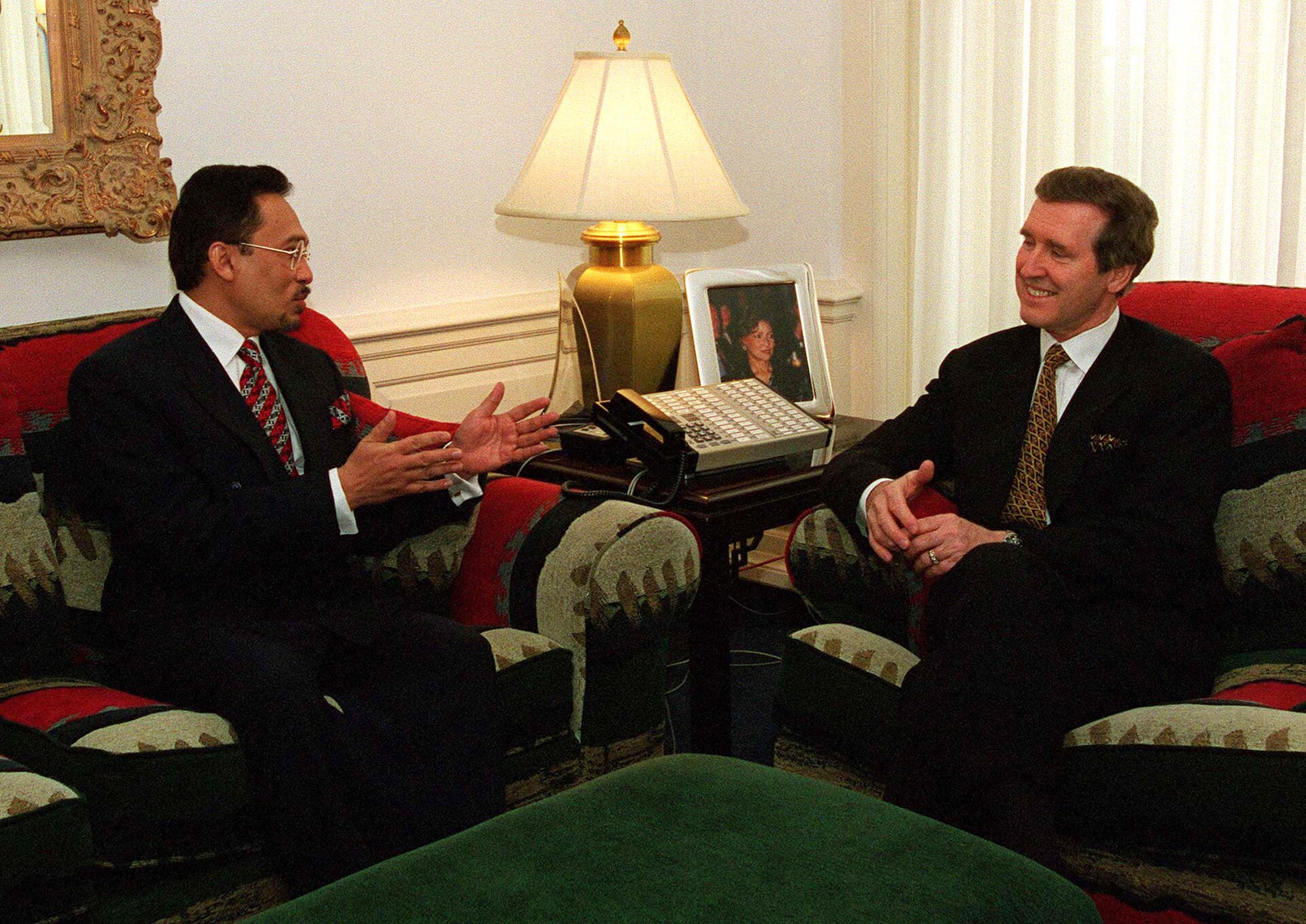
DoD photo by Helene C. Stikkel · Public domain
Anwar sacking and Reformasi
How Anwar Ibrahim’s removal from government in 1998 turned calls for reform into a national opposition movement.
What happened
On 2 September 1998, Mahathir Mohamad removed Anwar Ibrahim from the posts of Deputy Prime Minister and Finance Minister. The split took place during the Asian financial crisis, amid publicly visible disagreements over economic policy.
Anwar then addressed gatherings calling for political reform. The word “Reformasi” became associated with those calls and the protests that followed. Police arrested him on 20 September after a major Kuala Lumpur rally, and he subsequently faced corruption and sodomy charges.
The cases had legal as well as political consequences. Anwar was convicted of corruption in 1999 and later of sodomy; the Federal Court overturned the sodomy conviction in 2004. A Royal Commission of Inquiry also examined injuries Anwar received in custody, and former police chief Abdul Rahim Noor admitted assaulting him.
Politically, Reformasi organisers established keADILan in April 1999 and joined PAS, DAP and Parti Rakyat Malaysia in Barisan Alternatif. In the November election, the coalition won 42 parliamentary seats, while Barisan Nasional retained 148 of 193 seats and its two-thirds majority.
What the sources say
On 2 September 1998, Prime Minister Mahathir Mohamad removed Anwar Ibrahim from his posts as Deputy Prime Minister and Finance Minister.
The dismissal came during the Asian financial crisis, when tensions between Mahathir and Anwar over economic policy had become public.
After his dismissal, Anwar addressed public gatherings calling for political reform; “Reformasi” became the name and rallying call of the movement associated with these protests.
On 20 September 1998, police arrested Anwar after a major Reformasi rally in Kuala Lumpur; he was initially detained under the Internal Security Act (ISA).
Anwar appeared in court on 29 September 1998 after nine days held incommunicado, and faced criminal allegations including corruption and sodomy.
On 14 April 1999, the High Court convicted Anwar on corruption charges and sentenced him to six years’ imprisonment.
Anwar was later convicted of sodomy and sentenced to nine years’ imprisonment; on 2 September 2004, the Federal Court, by a 2–1 majority, overturned that conviction and he was released.
A Royal Commission of Inquiry examined Anwar’s injuries while in police custody; former Inspector-General of Police Abdul Rahim Noor admitted to the commission that he had assaulted Anwar.
Reformasi organisers relaunched the small party Ikatan Masyarakat Islam Malaysia as Parti Keadilan Nasional (keADILan) on 4 April 1999, enabling it to contest that year’s general election.
keADILan joined PAS, DAP and Parti Rakyat Malaysia in the opposition Barisan Alternatif for the 1999 election.
In the 29 November 1999 general election, Barisan Nasional won 148 of 193 parliamentary seats, while Barisan Alternatif won 42; PAS won 27, DAP 10 and keADILan five.
Academic and political analyses identify the 1999 election as an important early instance of opposition parties coordinating nationally through Barisan Alternatif, although Barisan Nasional retained its two-thirds majority.
No publicly accessible Cabinet minutes or UMNO internal record setting out a fuller formal rationale for Anwar’s dismissal has been located; the contemporaneous Bernama account records Mahathir saying he need not state reasons for the party decision.
Perdana Leadership Foundation digital archive / BernamaNational Archives of Malaysia finding aid
No source located can isolate Reformasi’s causal contribution to the 1999 election from the financial crisis, economic recovery, party strategy and electoral structure.
No complete primary-government publication of the Royal Commission of Inquiry’s report and all follow-up actions has been located; publicly accessible secondary and professional records describe its findings and recommendation concerning Abdul Rahim Noor.
Where accounts differ
Mahathir said Anwar was removed because he was “morally unfit,” while Anwar denied the allegations against him.
Anwar described the corruption prosecution as a political conspiracy intended to remove him and preserve Mahathir’s power; this was Anwar’s account, not a finding made by the courts in the conviction.
Amnesty International argued that the arrests and trials reflected political manipulation of state institutions and treated Anwar as a prisoner of conscience; the Malaysian government and courts proceeded with the prosecutions.
The precise reason for the dismissal remains disputed: academic accounts place it in the context of a leadership conflict and economic-policy differences during the financial crisis, while contemporaneous official reporting gave no reason for the dismissal itself.
Common questions
What happened when Anwar Ibrahim was sacked in 1998?
Anwar Ibrahim was removed as Deputy Prime Minister and Finance Minister on 2 September 1998. He then addressed public gatherings calling for political reform, with “Reformasi” becoming the name and rallying call associated with the movement and protests that followed.
Why was Anwar Ibrahim removed from government?
The reason for Anwar’s removal was disputed. Mahathir Mohamad said Anwar was “morally unfit,” while Anwar denied the allegations against him. Academic accounts place the split amid a leadership conflict and disagreements over economic policy during the Asian financial crisis; contemporaneous official reporting did not give a reason for the dismissal itself.
What did Reformasi mean in 1998?
Reformasi was the name and rallying call for the movement associated with Anwar’s calls for political reform and the protests after his dismissal. On 20 September 1998, police arrested Anwar after a major Reformasi rally in Kuala Lumpur, initially detaining him under the Internal Security Act.
What happened to Anwar after his arrest?
After his arrest, Anwar appeared in court on 29 September 1998 after nine days held incommunicado and faced allegations including corruption and sodomy. The High Court convicted him on corruption charges in April 1999 and sentenced him to six years’ imprisonment.
What happened to Anwar’s sodomy conviction?
The Federal Court overturned Anwar’s sodomy conviction on 2 September 2004 by a 2–1 majority, and he was released. The conviction had carried a nine-year prison sentence, after an earlier corruption conviction in 1999 had brought a separate six-year sentence.
How did Reformasi affect the 1999 election?
Reformasi organisers relaunched a small party as Parti Keadilan Nasional, or keADILan, in April 1999 so it could contest that year’s general election. keADILan then joined PAS, DAP and Parti Rakyat Malaysia in Barisan Alternatif; the coalition won 42 parliamentary seats in the 29 November election, while Barisan Nasional won 148 of 193.