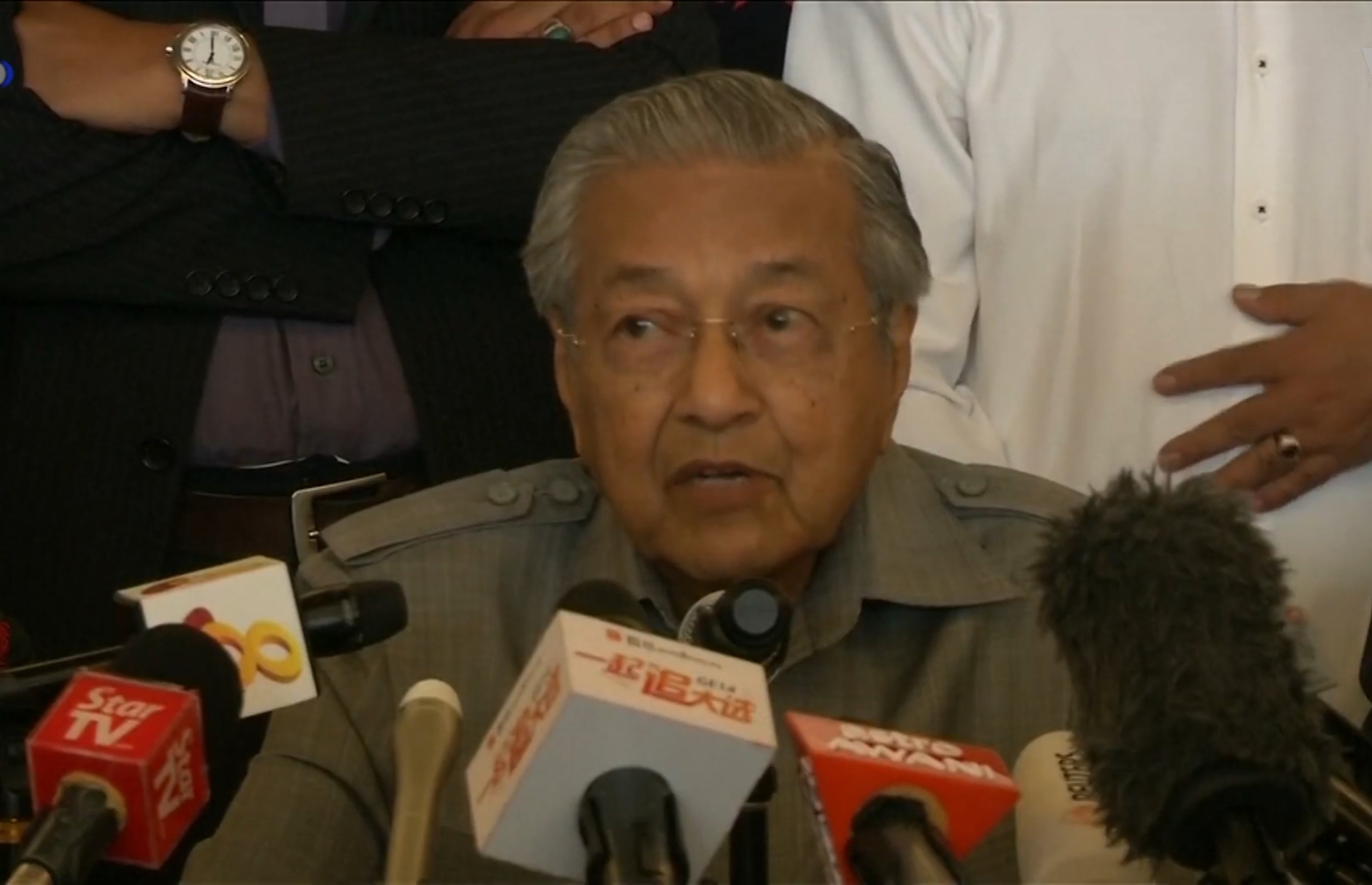
GE14 change of government
On 9 May 2018 Malaysians voted in the 14th general election and, for the first time since independence in 1957, the governing side lost its parliamentary majority and handed over power. That side had held the federal government continuously since 1957 — first as the Alliance, and later as its broader successor coalition, Barisan Nasional.
Photo: Voice of America · Public domain · Wikimedia Commons
what happened
Malaysia went to the polls on Wednesday 9 May 2018 to fill 222 federal seats. Turnout was high: the Election Commission's revised final figure was 82.32%, or about 12.3 million of 14.9 million registered voters. When the results were tallied, Barisan Nasional held 79 seats and PAS 18, while the parties of Pakatan Harapan together passed the 112-seat threshold needed to govern. It was the first time since 1957 that the federal government changed hands at an election.
The opposition had arrived at that election in an awkward legal position. The Registrar of Societies had not processed Pakatan Harapan's registration as a coalition, and a provisional deregistration order had been issued against Bersatu in April, so all four component parties campaigned under the PKR logo. The coalition was only formally registered on 16 May, a week after it won. That detail is one reason different sources report different seat totals for the winning side: The Star's Election Commission-based tally gives the registered Pakatan components 113, while Malaysiakini reports 122 by including Parti Warisan Sabah's eight seats and an independent.
The handover ran through the Federal Constitution's confidence rule. Article 43(2)(a) requires the Yang di-Pertuan Agong to appoint as Prime Minister the member of the House of Representatives who in his judgment is likely to command the confidence of a majority; Article 43(4) requires a Prime Minister who loses that confidence to resign the Cabinet or seek a dissolution. Mahathir Mohamad was sworn in by Yang di-Pertuan Agong Sultan Muhammad V at Istana Negara at 9.57pm on 10 May 2018, about 29 hours after polls closed, at the end of a day in which the palace at one point said no ceremony would be held. Cabinet ministers took office on 21 May, with Wan Azizah Wan Ismail becoming the first female Deputy Prime Minister.
The early months delivered several of the new government's headline commitments and opened questions it did not settle. Najib Razak and Rosmah Mansor were barred from leaving the country on 12 May; Anwar Ibrahim received a full pardon under Article 42 and was released on 16 May; the Goods and Services Tax was zero-rated from 1 June and a Sales and Services Tax reinstated from 1 September; Najib was charged over SRC International funds on 4 July. The SRC case ended with a conviction upheld by the Federal Court in 2022. A Council of Eminent Persons under Daim Zainuddin and an Institutional Reforms Committee including Ambiga Sreenevasan and Shad Saleem Faruqi were appointed; the IRC report was not released at the time and was still unpublished in January 2023. The government said it intended to ratify the remaining United Nations human-rights instruments, including ICERD, before deciding not to accede to ICERD; it also acceded to and then withdrew from the Rome Statute.
Analysts disagree about why Barisan Nasional lost. Bridget Welsh describes an UMNO collapse driven by emotion and "saviour" politics; Muhamad Nadzri reads it as the end point of a long structural decline; Oliver and Ostwald argue the boundaries still favoured Barisan and that its popular support simply fell too far; John Funston points to the three-way contest for Malay voters. Whether the swing was specifically Malay is itself disputed, with Ibrahim Suffian of Merdeka Center describing a diffused Malay shift and Thomas Pepinsky finding a decline across both Malay and non-Malay constituencies. The Pakatan Harapan federal government ended in February 2020 without an election: MPs led by Muhyiddin Yassin and Azmin Ali left the coalition, Mahathir resigned on 24 February, and Muhyiddin was sworn in as the eighth Prime Minister on 1 March 2020.
the working
What the sources say
established
The 13th Parliament was dissolved on 7 April 2018 by then Prime Minister Najib Razak, and the Election Commission set nomination day for Saturday 28 April 2018, early voting for 5 May 2018, and polling for Wednesday 9 May 2018, with an 11-day campaign period.
Election Commission chairman Mohd Hashim Abdullah announcing the GE14 timetable · General Election (2018) — Infographics
established
Polling closed at 5pm on 9 May 2018.
All you need to know about GE14… in numbers · POLLING DAY: Malaysia waits as voting for GE14 ends
established
222 federal seats in the Dewan Rakyat were contested; 112 seats is a simple majority.
14th General Election Malaysia (GE14 / PRU14) — Results Overview · GE14 Live Reports and Results
established
The Election Commission's revised final turnout was 82.32%, or 12,299,514 votes cast out of 14,940,624 registered voters, up from an initial figure of about 76% announced on polling night.
Election Commission figures as reported in EC revises voter turnout figures to 82.32% · GE14 Live Reports and Results
established
On Election Commission results as compiled by news organisations, Barisan Nasional won 79 federal seats and PAS won 18; Pakatan Harapan's own component parties won 113 between them, above the 112-seat threshold.
14th General Election Malaysia (GE14 / PRU14) — Results Overview · GE14 Live Reports and Results
established
Reported seat totals for the winning side differ between sources because they group parties differently, not because the underlying count is unsettled: The Star's portal gives Pakatan Harapan's registered components 113 seats (PKR 48, DAP 42, Bersatu 12, Amanah 11 in that portal's grouping), while Malaysiakini's results table reports 122 for "Harapan" by folding in Parti Warisan Sabah's 8 seats and one allied independent. Because Bersatu candidates contested on the PKR logo, party-level attribution also varies between sources.
14th General Election Malaysia (GE14 / PRU14) — Results Overview · GE14 Live Reports and Results
established
The Election Commission’s MySPR Semak service provides an official PRU14 results interface; the results are constituency-level declarations rather than a single nationwide gazetted return.
established
ElectionData.MY groups the GE14 popular vote as Pakatan Harapan 5,518,906 (45.7%), Barisan Nasional 4,081,063 (33.8%), Gagasan Sejahtera 2,041,200 (16.9%), Warisan 280,520 (2.3%), and others; these are grouping-dependent figures and are not the only possible post-election-bloc presentation.
established
Pakatan Harapan contested GE14 without its own registered coalition logo. The Registrar of Societies said in March 2018 that it could not process the coalition's registration because component party Parti Pribumi Bersatu Malaysia (Bersatu) had not supplied documents required under section 14(2) of the Societies Act 1966; Pakatan's parties went on to contest under PKR's ticket and logo in Peninsular Malaysia.
Pakatan Harapan registration still cannot be processed · Finally · Pakatan to use PKR logo in GE14
established
The Registrar of Societies approved Pakatan Harapan's registration as a formal coalition on 16 May 2018, after the election.
Finally · Pakatan Harapan registration still cannot be processed
established
Article 43(2)(a) of the Federal Constitution provides that the Yang di-Pertuan Agong "shall first appoint as Perdana Menteri (Prime Minister) to preside over the Cabinet a member of the House of Representatives who in his judgment is likely to command the confidence of the majority of the members of that House."
Federal Constitution of Malaysia · corroborated in The monarch's discretionary powers
established
Article 43(4) provides that if the Prime Minister ceases to command the confidence of the majority of the House, then unless at his request the Yang di-Pertuan Agong dissolves Parliament, the Prime Minister shall tender the resignation of the Cabinet.
Federal Constitution of Malaysia · corroborated in ROYAL ROLE ON ISSUE OF CONFIDENCE
established
Mahathir Mohamad was sworn in as Malaysia's seventh Prime Minister by Yang di-Pertuan Agong Sultan Muhammad V at Istana Negara at 9.57pm on 10 May 2018, aged 92.
At 92 · Mahathir Takes Oath as Malaysia's New Prime Minister
established
The swearing-in took place about 29 hours after polls closed at 5pm on 9 May, after a day in which Istana Negara said at one point that no ceremony would be held that day and the timing shifted more than once.
Report: PM swearing-in ceremony tonight · Anticipation builds at Istana Negara for Dr M's swearing-in as PM
uncertain
Mahathir described the delay as resulting from “certain official processes”, and reporting records that the Yang di-Pertuan Agong interviewed opposition-party leaders before appointing him; no authoritative public account sets out the complete changing schedule step by step.
established
The first Cabinet ministers of the new government were sworn in on 21 May 2018, and Wan Azizah Wan Ismail became Malaysia's first female Deputy Prime Minister.
Malaysia makes history as first female deputy PM Wan Azizah sworn in · Dr M leaves Putrajaya for Cabinet swearing-in
established
On 12 May 2018 the Immigration Department confirmed that Najib Razak and his wife Rosmah Mansor had been barred from leaving the country, after an earlier denial the same day.
established
On 16 May 2018 the Pardons Board for the Federal Territories, chaired by the Yang di-Pertuan Agong, met at Istana Negara and, under Article 42 of the Federal Constitution, a full pardon was granted to Anwar Ibrahim with immediate release.
Istana Negara statement as reported in Istana Negara says Anwar a free man · Malaysia politician Anwar Ibrahim released after royal pardon
established
The Goods and Services Tax was zero-rated from 1 June 2018 and a Sales and Services Tax was reinstated from 1 September 2018, delivering a headline item of Pakatan Harapan's 100-day manifesto.
Malaysia: The Resurrection of Sales and Services Tax · Return of the SST
established
On 4 July 2018 Najib Razak was charged with three counts of criminal breach of trust and one count of abuse of power over RM42 million from SRC International, and claimed trial in the Kuala Lumpur High Court.
Prosecution reads out CBT charges against Najib over SRC funds · Najib Razak
adjudicated
The SRC International case ran to a final verdict after the Pakatan Harapan government had fallen. The Kuala Lumpur High Court convicted Najib Razak on all seven charges on 28 July 2020 and sentenced him to 12 years' imprisonment and a fine of RM210 million; the Court of Appeal dismissed his appeal on 8 December 2021; and on 23 August 2022 the Federal Court unanimously dismissed his final appeal, affirming the conviction and sentence, and he began serving the sentence.
Federal Court of Malaysia · SRC case verdict: Najib found guilty on all seven charges · Court unanimously throws out Najib's appeal
established
On 29 January 2024 the Federal Territories Pardons Board halved Najib's SRC prison term to six years and reduced the fine from RM210 million to RM50 million, giving a projected release date of 23 August 2028. The Malaysian Bar sought judicial review of that decision; the High Court refused leave on 11 November 2025 and the Court of Appeal reserved judgment on the Bar's appeal on 31 July 2026. A separate bid by Najib to serve the remainder of the sentence under house arrest was discontinued on 2 April 2026.
Appeals court reserves judgment in Malaysian Bar's appeal over Najib's sentence reduction · Pardons Board agrees to cut Najib's jail term by half · Malaysia's Najib drops appeal to serve 1MDB-linked prison sentence under house arrest
established
Mahathir appointed a five-member Council of Eminent Persons chaired by Daim Zainuddin to advise on economic and institutional questions for 100 days, and an Institutional Reforms Committee that included Ambiga Sreenevasan and Shad Saleem Faruqi; the IRC submitted its final report on 7 August 2018. The report was not released at the time, and it was still unpublished in January 2023, when the reform group G25 backed a call by Ambiga Sreenevasan for the government to release it; whether it has been published since has not been verified here.
Ambiga · Institutional Reforms Committee submits final report to CEP · G25
established
The publicly identified IRC recommendations included reforms concerning Parliament, the Attorney General and public prosecutor, MACC, police, immigration, communications, electoral administration, appointments and certain laws; the full CEP and IRC reports were not released as complete public documents.
established
A pre-GE14 Pakatan Harapan document was publicly described as naming Mahathir Mohamad as prime-ministerial candidate and Anwar Ibrahim as his successor, without a specific handover date or timeframe; no complete authoritative text establishes further binding terms.
established
On 12 June 2018 the four Sarawak component parties of Barisan Nasional — PBB, SUPP, PRS and PDP — left the coalition and formed Gabungan Parti Sarawak.
GPS takes Sarawak in a new direction · Sarawak component parties pull out of BN
established
Addressing the UN General Assembly on 28 September 2018, Mahathir said the new government would ratify all remaining United Nations human rights instruments, which would have included the Convention on the Elimination of All Forms of Racial Discrimination (ICERD). On 23 November 2018, after weeks of opposition from Malay and Muslim groups, the Cabinet decided not to accede to ICERD.
Statement by Mahathir bin Mohamad · Putrajaya says no to ICERD · Saifuddin: Cabinet made unanimous decision on ICERD
established
The government acceded to the Rome Statute of the International Criminal Court in March 2019 and announced withdrawal from it on 5 April 2019.
Malaysian Bar: Rome Statute withdrawal affects Malaysia's international credibility · Malaysia backtracks on accession to the Rome Statute
established
The Pakatan Harapan federal government ended in February 2020 without an election, when MPs led by Muhyiddin Yassin and Azmin Ali withdrew from the coalition; Mahathir submitted his resignation to the Yang di-Pertuan Agong on 24 February 2020 and Muhyiddin was sworn in as the eighth Prime Minister on 1 March 2020.
Newsmakers 2020: Power shifts from Pakatan Harapan to Perikatan Nasional · PKR sues defectors over Sheraton Move that toppled PH govt
where accounts differ
The parts nobody agrees on
contested
Bridget Welsh argues the result is best explained as an "UMNO collapse" driven by emotion and "saviour" politics in the campaign, amplified by social media, rather than by a single policy grievance.
contested
Muhamad M. N. Nadzri frames the outcome within a longer arc of Malaysian political development from 1957, treating the fall of Barisan Nasional as the culmination of structural decline rather than a 2018-specific shock.
contested
Steven Oliver and Kai Ostwald argue that malapportionment and partisan bias in the electoral boundaries continued to favour Barisan Nasional in 2018, and that the coalition lost despite that advantage because its popular support fell sharply relative to 2013.
Steven Oliver and Kai Ostwald · Kai Ostwald and Steven Oliver
contested
Whether GE14 constituted a "Malay tsunami" is disputed. Ibrahim Suffian of Merdeka Center described a Malay swing that was "diffused across state and contesting parties" rather than uniform, while Thomas Pepinsky, analysing peninsular constituency data, argued that support for Barisan Nasional fell "all across the board" among both Malay and non-Malay voters and characterised it as a broad Malaysian swing rather than a specifically Malay one.
'Malay tsunami' not strong enough to drown BN · Thomas Pepinsky
contested
John Funston attributes the outcome primarily to the three-cornered contest for the Malay electorate between UMNO, PAS and the Pakatan Harapan parties.
contested
Funston separately argues against reading the result as a collapse of UMNO's own base: on his calculation UMNO still took the largest single share of the peninsular Malay vote, about 36.6% against about 31.7% each for PAS and Pakatan Harapan, and he describes the outcome as a rejection of Barisan Nasional's record in government rather than of Malay political preeminence.
contested
Najib Razak, who resigned as Barisan Nasional and UMNO chairman after the defeat, gave a different account of it. Speaking in June 2018 he attributed the loss to what he called Pakatan Harapan's false promises rather than to his government's agenda — "My disappointment is not because our agenda was not good but because our loss was due to false promises" — and to UMNO's internal handling of campaign money, saying candidates had sulked over allocations, denied receiving funds they had received, or failed to spend them. He said he had contributed to the failure and had resigned to take responsibility.
Najib: We lost even after spending so much due to Pakatan's false promises
contested
Pre-election polling failed to anticipate the result, and pollsters disagree on why. Ibrahim Suffian of Merdeka Center said his model wrongly assumed undecided voters would break for Barisan Nasional and that his firm "overcompensated for BN by a huge margin, around 10 percentage points"; Syed Arabi Idid of IIUM said he had expected at best a hung Parliament because of the effect of redelineation.
contested
The legal effect of Anwar Ibrahim's pardon — whether "pengampunan sepenuhnya" (full pardon) amounts to a free pardon wiping the conviction, or only remits the sentence — was debated after 2018 among lawyers and commentators. No court ruling settling that question is cited here.
Free pardon or full pardon? AG's letter fuels new debate over Anwar's eligibility · Shad Saleem Faruqi
contested
Why the reform agenda stalled is disputed. Kai Ostwald and Steven Oliver locate the difficulty in competing pressures across several political arenas at once; the East Asia Forum analysis of the Rome Statute reversal attributes it instead to objections raised on grounds touching the monarchy, Malay privileges and Islam.
Kai Ostwald and Steven Oliver · Royalty and religion scupper Malaysia's ascendency to the ICC
still being researched
- Whether a single nationwide gazetted GE14 result is publicly accessible, beyond the Election Commission’s constituency-level results interface.
- What further binding terms, if any, were contained in the pre-GE14 Mahathir–Anwar transition agreement beyond the publicly described successor arrangement.
- What recommendations in the complete CEP and IRC reports were not publicly identified.
- Barisan Nasional published no post-election review of its own, so the coalition's explanation of the defeat is on the record only through individual leaders' statements rather than an agreed party account.