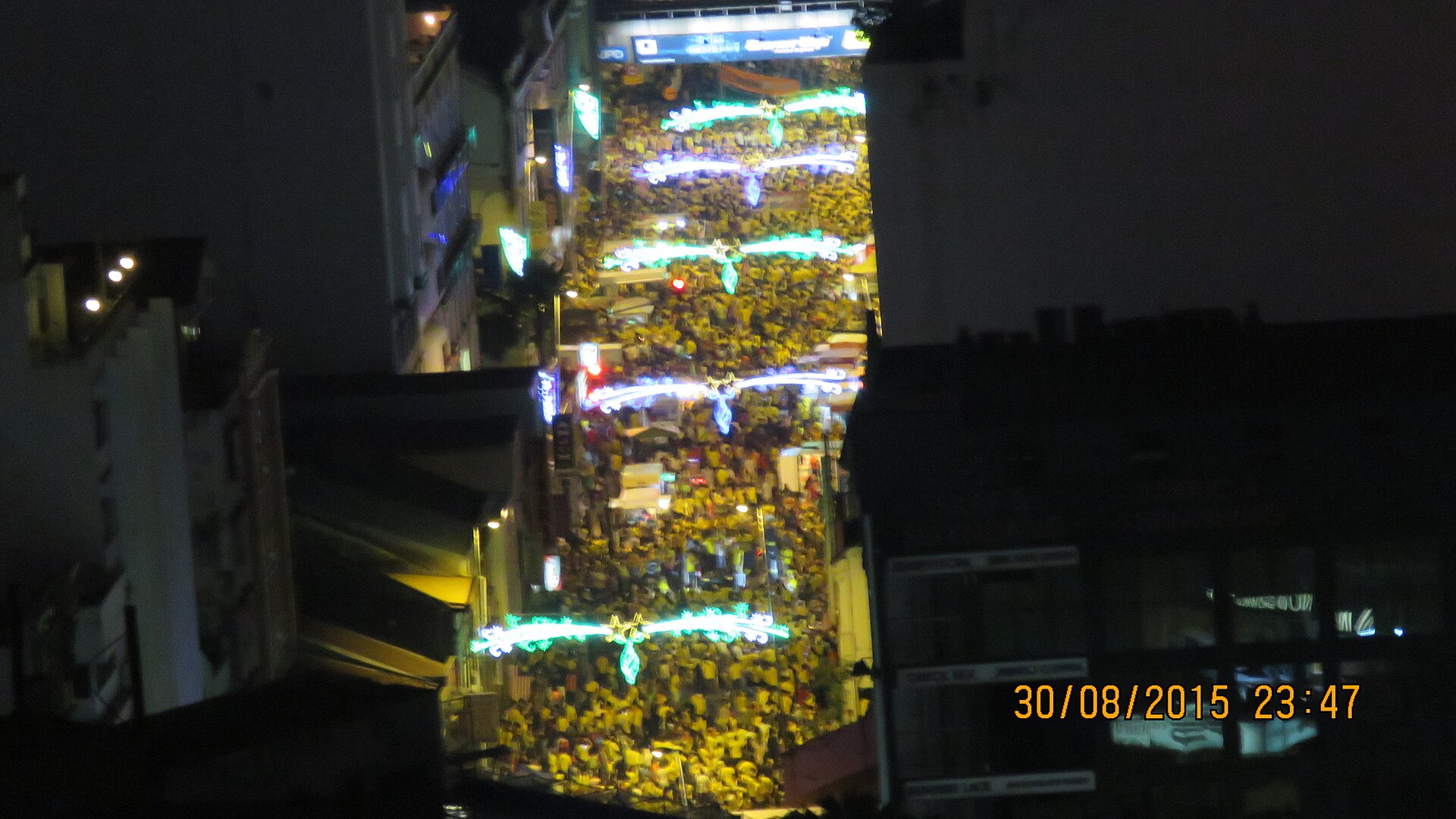
Apa masalah · CC BY-SA 4.0
Bersih rallies (2007-2016)
The five Bersih public rallies from 2007 to 2016 called for electoral reform and accountability and had immediate political effects.
What happened
Between 2007 and 2016, Bersih organised five major rallies centred first on electoral reform and later also on clean government and institutional accountability. The movement’s name means “clean” in Malay, and yellow became its recognisable colour.
The 2007, 2011 and 2012 events focused directly on how elections were run: voter rolls, postal voting, campaign conditions, media access and the Election Commission. After the 2011 rally, the government established a parliamentary select committee to study the election process, and that committee reported in April 2012.
The rallies also raised questions about public assembly and policing. Police used tear gas and water cannon at the 2007 event. SUHAKAM later found excessive force at Bersih 2.0 and disproportionate force and misconduct at Bersih 3.0; police had a different account of why force was used at the 2012 rally.
By 2015 and 2016, Bersih’s public demands included Najib Razak’s resignation and broader institutional reforms. Bersih 5 proceeded after chairperson Maria Chin Abdullah was detained under SOSMA the previous day.
It remains difficult to separate the rallies’ effect from wider political developments. Some researchers and commentators credit Bersih as one contributing factor to opposition advances, while crowd figures and assessments of the rallies’ longer-term impact remain disputed.
What the sources say
No single independently verified turnout series has been located for all five Bersih rallies; attendance estimates remain attributable to their estimators and are contested where they differ.
Research identifies Bersih’s effects on political efficacy, mobilisation and electoral-reform debate, but does not isolate the vote effect of any one rally from other political, economic and campaign factors.
Parliament’s report records the 2011–12 electoral-reform parliamentary select committee’s recommendations, but no complete verified audit matching every recommendation to its implementation status before GE13 has been located.
Parliament of Malaysia — PSC reportParliament archive of the committee
The movement and rallies
Bersih is short for the Coalition for Clean and Fair Elections; “bersih” means “clean” in Malay, and yellow became the movement’s recognisable rally colour.
Bersih movement studyMalaysians Gather Peacefully to Demand a New Politics
10 November 2007
Scholars describe five major Bersih street rallies in this period: 10 November 2007, 9 July 2011, 28 April 2012, 29–30 August 2015, and 19 November 2016.
10 November 2007
The first rally took place in Kuala Lumpur on 10 November 2007 and called for electoral reform; police used tear gas and water cannon to disperse demonstrators.
9 July 2011
Bersih 2.0 was held in Kuala Lumpur on 9 July 2011. Its eight demands included cleaning the electoral roll, postal-ballot reform, indelible ink, a minimum 21-day campaign, fair media access, stronger institutions, stopping corruption, and stopping “dirty politics.”
Constituency Delineation — Knowing Where to Draw the LinesThe Bersih 2.0 public rally … 9th July 2011
28 April 2012
Bersih 3.0 was a sit-in planned for 28 April 2012 in Malaysia and other locations; Bersih said it sought electoral-roll clean-up, reform of postal voting, use of indelible ink, and action against “dirty politics,” as well as the resignation of the Election Commission.
30 August 2015
Bersih 4 took place from 29 to 30 August 2015 in Kuala Lumpur, Kuching and Kota Kinabalu. Bersih called for Prime Minister Najib Razak’s resignation and institutional reforms.
BERSIH 4: The Time Has ComeMalaysians Gather Peacefully to Demand a New Politics
19 November 2016
Bersih 5 was held on 19 November 2016. It was organised by Bersih and called for changes including clean government, stronger parliamentary democracy and electoral reform.
Thousands of Malaysians March Against GovernmentBersih 5 complaint to SUHAKAM
Direct political and institutional consequences
After Bersih 2.0, Prime Minister Najib Razak announced a parliamentary select committee on electoral reform on 15 August 2011; the Dewan Rakyat appointed the committee on 3 October 2011 to study election-process issues.
Parliamentary Select Committee archiveConstituency Delineation — Knowing Where to Draw the Lines
The committee’s final report was tabled in the Dewan Rakyat on 3 April 2012. The Malaysian Bar said the report was incomplete and inadequate for free and fair elections; that was the Bar’s assessment, not a parliamentary finding.
Parliamentary Select Committee archiveFinal report of PSC incomplete
Malaysia’s 2008 general election returned Barisan Nasional to government but without its two-thirds Dewan Rakyat majority; it won 140 of 222 seats.
Election poses no hurdles to governanceThe 2008 Malaysian Elections: An End to Ethnic Politics?
A SUHAKAM inquiry found that police used excessive force in dispersing Bersih 2.0 demonstrators in July 2011, including tear gas near hospitals.
A SUHAKAM inquiry into Bersih 3.0 found disproportionate police force and misconduct, according to the commission’s published findings.
SUHAKAM 2013 Annual ReportSuhakam: Police used ‘disproportionate force’ on Bersih crowd
Maria Chin Abdullah, Bersih 2.0’s chairperson, was detained on 18 November 2016, the day before Bersih 5, under the Security Offences (Special Measures) Act 2012 (SOSMA).
Bersih statement on the detentionWho Is the Woman at the Heart of Malaysia’s Anti-Corruption Protests?
Where accounts differ
Estimates of turnout differed substantially. For Bersih 4, Time reported organisers’ estimate of 200,000 and police’s estimate of 20,000; neither figure can be treated here as a verified total.
Huge Antigovernment Protests in Malaysia Continue for a Second Day
For Bersih 5, Time reported about 40,000 participants according to local media and an organiser estimate of twice that number.
Police said force at Bersih 3.0 was used after participants breached barricades and disobeyed a court order, while SUHAKAM later found disproportionate force and misconduct by police.
SUHAKAM 2013 Annual ReportPolice's teargas on Bersih 3.0 crowd was 'reasonable force'
Brookings says Bersih “contributed” to opposition gains in the 2008 election and that the 2011 and 2012 protests were credited as contributing factors to opposition gains in 2013; this is an interpretation of political causation, not a result that can be isolated from other factors.
UMNO Youth leader Khairy Jamaluddin said in 2011 that Bersih’s original NGO coalition had been “hijacked” by opposition parties and turned into an anti-government platform; this was his political characterisation.
Common questions
What was Bersih asking for in 2011?
Bersih 2.0 asked for changes to how elections were run. Its eight demands included cleaning the electoral roll, reforming postal ballots, using indelible ink, a minimum 21-day campaign, fair media access, stronger institutions, stopping corruption and stopping “dirty politics.”
Constituency Delineation — Knowing Where to Draw the LinesThe Bersih 2.0 public rally … 9th July 2011
What happened after Bersih 2.0?
Yes. After Bersih 2.0, Prime Minister Najib Razak announced a parliamentary select committee on electoral reform on 15 August 2011, and the Dewan Rakyat appointed it on 3 October 2011 to study election-process issues. Its final report was tabled in the Dewan Rakyat on 3 April 2012.
Parliamentary Select Committee archiveConstituency Delineation — Knowing Where to Draw the Lines
Why was Bersih 4 held?
Bersih 4 called for Prime Minister Najib Razak’s resignation and institutional reforms. The rally ran from 29 to 30 August 2015 in Kuala Lumpur, Kuching and Kota Kinabalu.
BERSIH 4: The Time Has ComeMalaysians Gather Peacefully to Demand a New Politics
What happened when police dispersed Bersih rallies?
Police used tear gas and water cannon to disperse demonstrators at the first Bersih rally in Kuala Lumpur in 2007. For later rallies, SUHAKAM found excessive force at Bersih 2.0 and disproportionate force and misconduct at Bersih 3.0; police said force at the 2012 rally followed a breach of barricades and disobedience of a court order.
Tear gasSUHAKAM 2013 Annual ReportPolice's teargas on Bersih 3.0 crowd was 'reasonable force'
How many people joined Bersih 4 and Bersih 5?
There is no single verified turnout figure for the Bersih rallies. For Bersih 4, Time reported organisers’ estimate of 200,000 and police’s estimate of 20,000; for Bersih 5, it reported about 40,000 participants according to local media and an organiser estimate of twice that number.
Huge Antigovernment Protests in Malaysia Continue for a Second DayThousands of Malaysians March Against Government